
One through nine in every row.
No number can appear twice in the same row.
BUILD THE FOUNDATION
Learn the structure, rules, and logic that turn a grid of numbers into a solvable puzzle.
THE BIG IDEA
Every empty cell has a set of possible numbers, also known as notes, candidates, potentials, possiblities, etc. The rules of the puzzle let you eliminate possibilities until one and only one number can be placed with certainty.
The goal isn't to find a number that looks right. The goal is to understand why every other possibility is impossible.
01 · THE GRID
A standard Sudoku has a 9×9 grid divided into 9 rows, 9 columns, or nine 3×3 boxes.
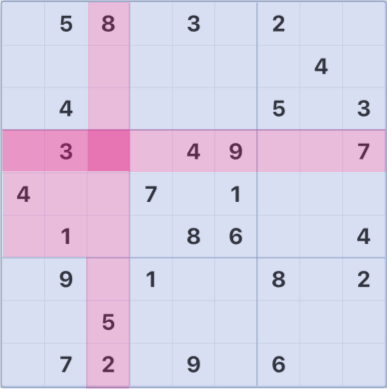
Each row must contain the numbers 1 through 9 exactly once.
Each column must contain the numbers 1 through 9 exactly once.
Each 3×3 box must contain the numbers 1 through 9 exactly once.
02 · THE THREE RULES
Everything you do while solving Sudoku comes back to these three constraints.
No number can appear twice in the same row.
No number can appear twice in the same column.
No number can appear twice inside a 3×3 box.
03 · THE LANGUAGE
In Sudoku, a house, also known as a unit, is any row, column, or 3×3 box.
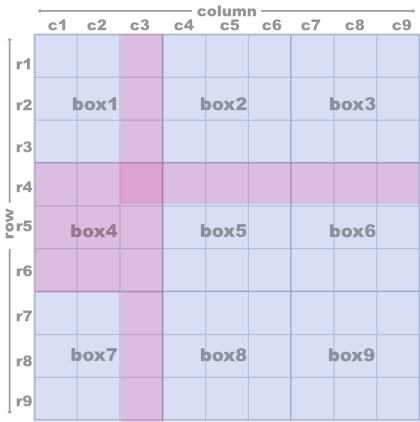
A cell belongs to exactly three houses: one row, one column, and one box. Those three houses are the places that constrain what can go into that cell.
This simple idea becomes the foundation for almost every solving technique.
04 · CANDIDATES
Before a cell is solved, we can track the numbers that are still allowed for that cell.
Start with every number from 1–9.
Use the cell's row, column, and box to eliminate numbers that already appear.
If only one candidate remains, the cell is solved.
05 · LOGICAL DEDUCTION
Sudoku solving is the process of removing possibilities. Every elimination gives you more information about what must be true.
WHAT COMES NEXT
You know the grid. You know the rules. You understand candidates and logical deduction. Now it's time to put that knowledge to work.