
SUDOKU 101 · HISTORY
The missing history of the 9×9 grid.
Sudoku feels timeless. Its history is anything but. Follow the puzzle from 18th-century mathematics through newspapers, Japan, and the worldwide ritual it became.
1782 · Before Sudoku
A mathematician was looking for order.
Leonhard Euler was not trying to invent Sudoku. He was exploring a broader mathematical idea: how symbols can be arranged without repeating. His work on Latin squares became part of the mathematical ancestry of Sudoku.

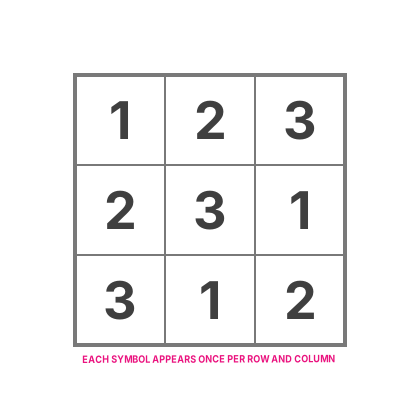
In a Latin square, every symbol appears exactly once in every row and exactly once in every column. That sounds simple. It turns out to be a deep and surprisingly fertile mathematical idea.
Euler's 36 Officers
Then came a question with 36 officers.
Euler asked whether 36 officers from six ranks and six regiments could be arranged in a 6×6 square so that every row and every column contained one officer of every rank and regiment combination. The problem became famous as the 36 Officers problem.
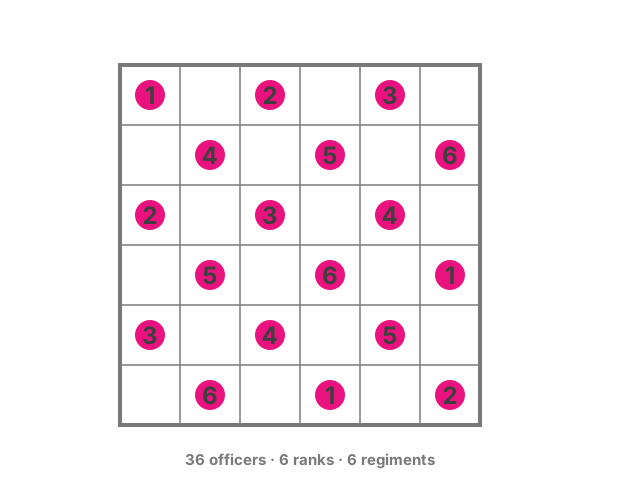
Euler believed the arrangement was impossible. Gaston Tarry finally proved the 6×6 case impossible in 1900. It was mathematics, not a puzzle book—but the same fascination with structured, non-repeating arrangements would echo much later in Sudoku.
The idea
No repeats.
Perfect order.
Euler's mathematics would sit quietly in the background for generations. Then, in France, the grid began to look like a puzzle.
1892–1895 · The forgotten French chapter
Sudoku didn't begin in Japan.
French newspapers published number-grid puzzles in the 1890s. A July 6, 1895 puzzle in La France is especially striking: a 9×9 magic square divided into smaller regions, filled with the numbers 1 through 9.
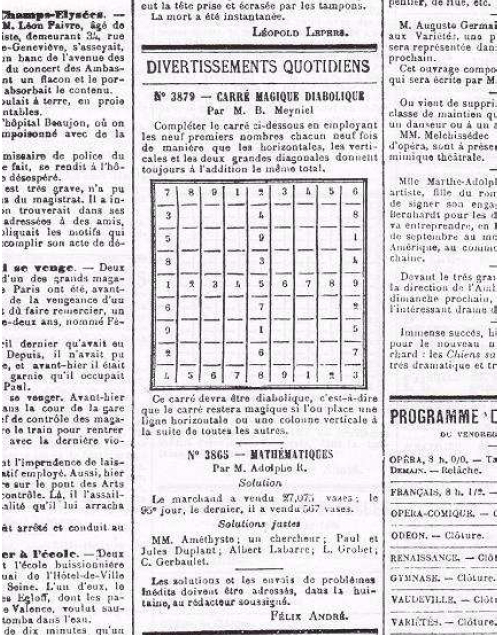
La France, July 6, 1895. Public-domain historical clipping. Source
It was not modern Sudoku. It was a magic-square puzzle with additional mathematical conditions, including diagonal requirements. But the family resemblance is hard to miss.
1979 · New York
An architect turned the idea into Number Place.
Howard Garns
A 74-year-old retired architect and puzzle constructor created the modern form of the puzzle. Dell published it as Number Place in 1979.
One familiar grid.
One crucial addition.

The defining twist was the nine 3×3 boxes. That extra layer turned a mathematical arrangement into the logic puzzle we recognize today.
1984 · Japan
Then the puzzle crossed the Pacific.
Japanese publisher Nikoli found Number Place in an American puzzle magazine and introduced it to Japanese readers in 1984. The first title was wonderfully descriptive—and much too long to say every time.
数字 (sūji) means “number/number,” while 独身 (dokushin) means “single” or “unmarried.” に限る (ni kagiru) means “to be limited to” or “be restricted to.” Nikoli later shortened the long title to Sudoku.
Nikoli didn't invent the puzzle, but it gave it a memorable identity and developed a distinctive publishing style. In 1986, the company adopted symmetrical clue placement as one of its puzzle-making rules.
BEFORE
SYMMETRY
1997 → 2004 · The escape
One man helped Sudoku leave Japan.
Wayne Gould
Gould, a retired Hong Kong judge from New Zealand, encountered Sudoku in a Tokyo bookshop. He spent roughly six years developing software that could generate puzzles.
The quiet puzzle
went daily.
The Times of London began publishing Sudoku in November 2004. From there, the puzzle spread rapidly through newspapers and into homes around the world.
A mathematical idea became a newspaper puzzle. A newspaper puzzle became a Japanese tradition. Then it became a daily ritual around the world.
One final number
How many completed Sudoku grids can exist?
That's about 6.67 sextillion valid completed classic 9×9 Sudoku grids. An enormous mathematical universe hiding inside 81 cells.
And now
The history is huge.
The next move is still just one cell.
Maybe that's part of the appeal. A puzzle can contain an almost unimaginable number of possibilities, yet solving it asks you to slow down, notice what is true, and take one reasoned step at a time.
Nikoli's official Sudoku history documents the 1984 introduction, the original Japanese title, its shortening to Sudoku, and the 1986 symmetry convention. Nikoli. Euler portrait: public-domain Wikimedia Commons reproduction of Handmann's 1753 portrait. Image source. 1895 La France puzzle: public-domain historical clipping. Image source. The custom diagrams on this page are original Zero to Hero graphics.