
Advanced technique · ALS · 01

ALS-XZ

Two almost locked sets. One restricted common candidate. A forced elimination.

AdvancedAlmost Locked SetsElimination

The idea

TWO ALMOST LOCKED SETS CONNECT THROUGH A RESTRICTED COMMON CANDIDATE.

Two ALS share two common candidates X and Z, number X is the RCC while number Z is unrestricted, any outside cell that sees all occurrences of number Z in both ALS can have number Z eliminated.

The question: Can two ALS share a restricted candidate X and a second candidate Z that becomes confined to one set or the other?

Walkthroughs

FOLLOW THE RESTRICTED COMMON CANDIDATE

Find two ALS that share number X and Z. X must be restricted between the two sets: every X in one set sees every X in the other. That means only one ALS can have X, so at least one set is forced to become locked when X is resolved.

Walkthrough

Example 01 — Recognize the structure

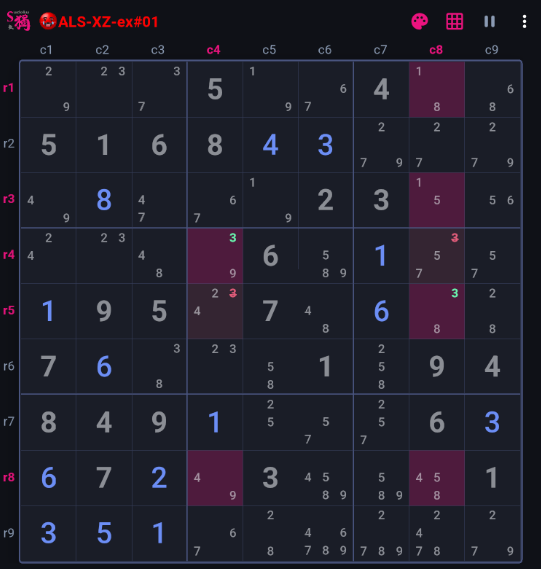
Here one ALS is two cells {r4c4, r8c4} with three numbers 3, 4 and 9, the other ALS is four cells {r1c8, r3c8, r5c8, r8c8} with five numbers 1, 3, 4, 5 and 8. Two ALS share numbers 3 and 4, where number 4 is RCC because the cells having number 4 from each ALS see each other. If the two-cells ALS had number 4, the four-cells ALS could not have number 4 thus would be locked to four numbers; similarly, if the four-cells ALS had number 4, the two-cells ALS would be locked to two numbers. Either way the unrestricted number 3 would be locked to either cell r4c4 or r5c8, therefore, any cell that sees both r4c4 and r5c8 can have number 3 eliminated.

What to notice: two ALS must have two common candidates, one is RCC, and the other one is the force for eliminations.
Placeholder for a ALS-XZ walkthrough screenshot

Walkthrough

Example 02 — Follow the consequence

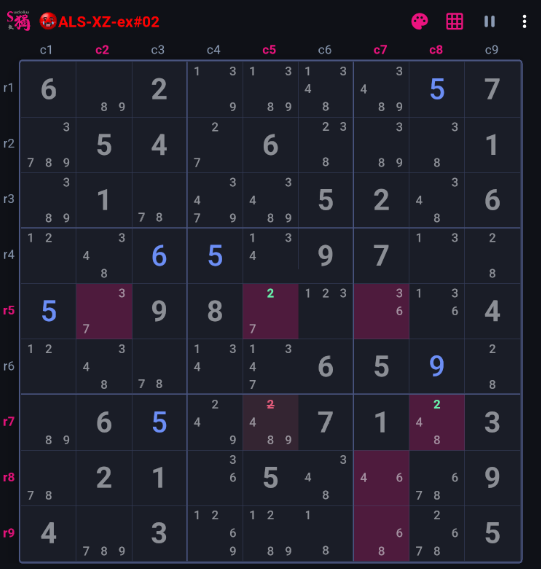
Here both ALS have three cells with four numbers, one is in row 5 with number 2, 3, 6 and 7, the other is in box 9 with number 2, 4, 6 and 8. The RCC is number 6, the unrestricted common candidate is number 2; therefore any outside cell that see all cells holding number 2 can have number 2 removed.

What to notice: The second shared number Z is confined to the surviving ALS, so a cell that sees every Z occurrence in both sets cannot contain Z.

Placeholder for a second ALS-XZ walkthrough screenshot

How it works

THE RESTRICTED LINK IS WHAT MAKES THE ELIMINATION CERTAIN.

Find two ALS. Verify X is genuinely restricted. Then track the second shared candidate Z: whichever ALS is not locked by X must contain Z within its cells.

01

Find the structure.

Start with small ALS: two or three cells whose combined candidates contain exactly one more number than the number of cells.

02

Confirm the relationship.

Choose an RCC X and verify every X in one ALS sees every X in the other.

03

Make the deduction.

Find a second shared digit Z and remove Z only from cells that see every Z in both ALS.

ALS 01

A useful reminder

THE RCC CARRIES THE PROOF.

Do not treat any shared candidate as restricted automatically. If even one pair of X candidates does not see each other, the ALS-XZ proof fails.

Watch & learn

Watch live here.

Coming soon...

Practice

VERIFY THE RCC BEFORE ELIMINATING.

Practice spotting the ALS first, then test candidate pairs for a true RCC before looking for the elimination zone.