
Advanced technique · Chains · 05

AIC

Alternating Inference Chains connect strong and weak links into a closed or endpoint proof.

AdvancedChainsLoop / AIC

The idea

ALTERNATING INFERENCE CHAINS GENERALIZE THE LINK IDEA.

An Alternating Inference Chain (AIC) uses alternating strong and weak links and can be read as a sequence of implications. These ideas let you move beyond one-number chains such as X-Chain and X-Cycle, or simple bivalue patterns such as XY-Chain. and XY-Cycle..

Similar to X-Chain and XY-Chain., an AIC can be open ended.

Similar to X-Cycle and XY-Cycle., closed AICs are classified into Discontinuous AICs and Continuous AICs. A continuous AIC (Nice Loop) supports eliminations from candidates connected to the chain and sharing a weak link with the loop nodes, while a discontinuous AIC can create a contradiction that proves either a placement or an elimination.

The question: Can the candidate links alternate all the way around a loop, or from one strong endpoint to another?

Walkthroughs

READ THE CHAIN AS A PROOF

Do not begin by memorizing loop shapes. Start with the links: strong, weak, strong, weak. Then follow the implications and inspect what the closure or endpoints prove.

Walkthrough

Example 01 — An open ended

A six cells multi-number open ended chain is illustrated below with green strong links and yellow weak links. The chain starts from cell r6c4 with candidates 2 and 3; if cell r6c4 were not number 2, cell r9c4 would be forced to number 8, then cell r6c5 would be forced to number 8, therefore, regardless what number cell r6c4 has, cell r6c5 cannot be number 2.

What to notice: The key is the contradiction created by the chain. You are not guessing the value; you are testing a premise and showing what cannot exist.
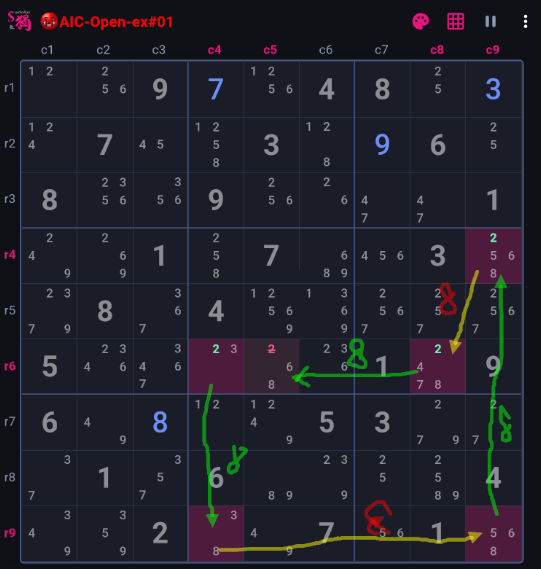
Placeholder for a Nice Loop / AIC walkthrough screenshot

Walkthrough

Example 02 — Another open ended

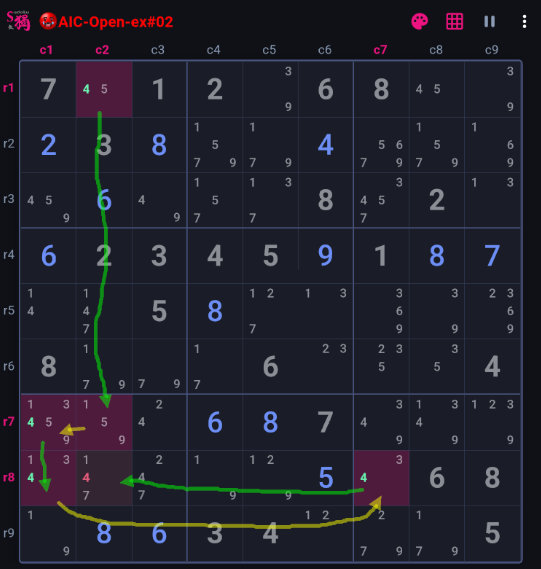
Here is a five cells multi-number chain; it looks like an XY-Chain or an X-Chain but instead of relying on shared number of bivalue cells or a single number, it uses strong and weak links with multiple numbers. The chain starts at cell r1c2, it is either number 4 or 5; if it were number 5, then cell r7c1 would be forced to number 5, in turn cell r8c1 would be forced to number 3, and cell r8c7 would be forced to number 4. Thereforce cell r8c2 cannot be 4 as cell r8c2 sees both chain ends with number 4.

What to notice: X-Chain and XY-Chain are simply specialized variations of AIC.

Placeholder for a Nice Loop / AIC walkthrough screenshot

How it works

ALTERNATE THE LINKS, THEN READ WHAT THE END PROVES.

A strong link says that if one side is false, the other must be true. A weak link says that if one side is true, the other must be false. Alternating those implications lets a premise travel around the chain. When the chain closes consistently, it creates a loop pattern; when the closure creates a contradiction, it proves the starting premise false. AICs use the same alternating logic even when the chain is not a simple named pattern.

01

Label the links.

For each connection, decide whether it is strong or weak. The chain must alternate.

02

Follow the implication.

Read the candidates as an ON/OFF sequence. If one candidate is true, the next weak link turns off; a strong link can then force the next candidate on.

03

Read the closure.

A contradiction can prove an assumption false; a continuous loop can support eliminations from candidates that conflict with the established pattern.

CHAIN 5

A useful reminder

THE LINK TYPES MATTER MORE THAN THE SHAPE.

AICs become much easier to understand when you stop looking for a picture and start reading the links. Every step must have a valid inference behind it.

Watch & learn

Watch live here.

Coming soon...

Practice

WRITE THE LINKS DOWN.

For early practice, annotate a candidate chain with strong and weak links before looking for the deduction. Once the alternating structure is clear, inspect the closure or endpoints for the consequence.