Advanced technique · Chains · 03

X-Cycle

One candidate forms a closed chain of alternating strong and weak links.

AdvancedChains & LoopsPlacement / Elimination

The idea

FOLLOW ONE NUMBER UNTIL THE CHAIN CLOSES BACK ON ITSELF.

An X-Cycle follows a single candidate number through a closed sequence of strong and weak links. The links alternate as you move around the cycle, but what happens when the loop closes determines the deduction.

A continuous loop closes cleanly. A discontinuous loop has a break where two links of the same type meet. That break is not a problem to ignore — it is the reason the loop can force a number to be placed or eliminated.

The question: Does the loop close cleanly, or does the closing point force a contradiction?

Walkthroughs

FIRST CLASSIFY THE LOOP. THEN READ THE DEDUCTION.

X-Cycles become much easier to read when you separate recognition from proof. Trace one number, mark every strong and weak link, and only then inspect the closing point. A clean alternation and a same-type break lead to different conclusions.

Walkthrough

Example 01 — Continuous loop

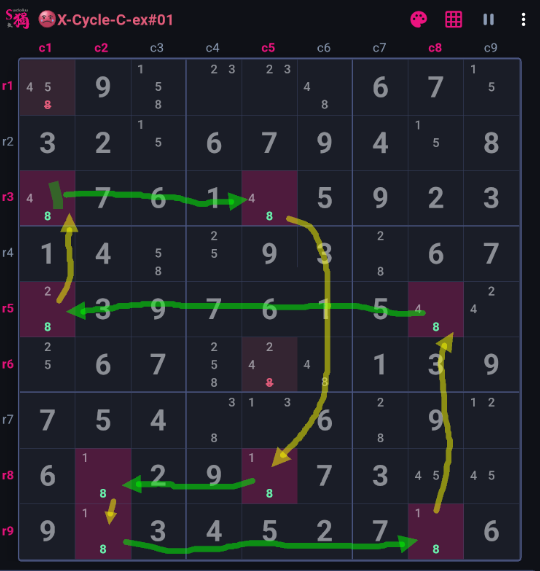
Digit 8 forms a closed loop starting from r3c1, traveling through cells r3c5, r8c5, r8c2, r9c2, r9c8, r5c8, r5c1 and back to the starting cell r3c1. As illustrated, green strong links and yellow weak links alternate all the way around the loop.

Because the loop closes without a break, every weak-link end cells in the loop behave as a forced pair and one of them must contain number 8. Therefore, any cell that sees both ends of a weak link can have number 8 eliminated.

What to notice: A continuous X-Cycle does not place the number directly in a loop cell. Its usual deduction is an elimination outside the loop.
Placeholder for a continuous X-Cycle walkthrough screenshot

Walkthrough

Example 02 — Discontinuous loop with two strong links

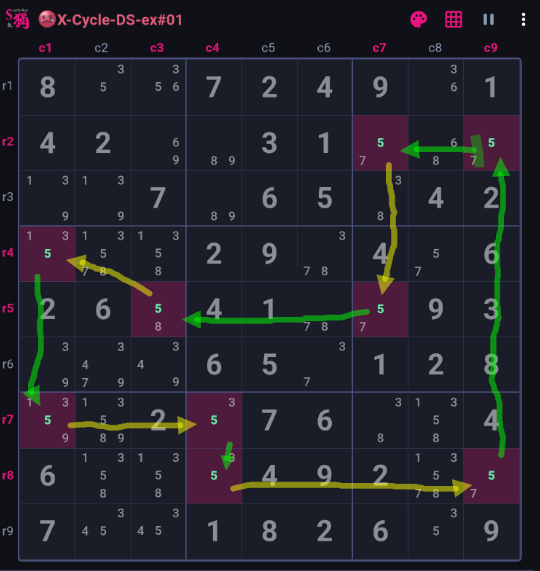
Now follow number 5 starting from cell r2c9, traveling through cells r2c7, r5c7, r5c3, r4c1, r7c1, r7c4, r8c4, r8c9 and back to the starting cell r2c9. Two links from and to cell r2c9 are all green strong links. If the number 5 were false at the starting cell r2c9, each strong link would force it back to true. The loop therefore forces the candidate to be true at the discontinuity.

That gives a placement: number 5 is the solution for the discontinuity cell r2c9, so every other candidate in cell r2c9 can be removed.

What to notice: Two strong links meeting at the break cell force the placement of the number to the cell.

Placeholder for a discontinuous X-Cycle strong-link walkthrough screenshot

Walkthrough

Example 03 — Discontinuous loop with two weak links

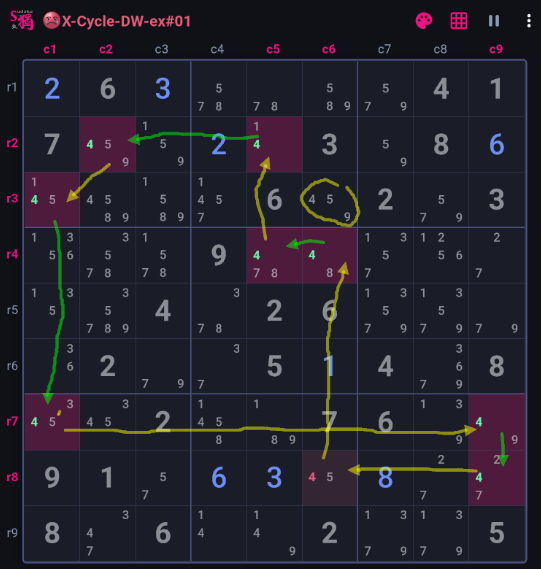
Digit 4 starts from cell r4c6 and loops back to itself through cell r8c6, which is connected by two weak links. If cell r8c6 were number 4, both weak links would immediately conflict with the rest of the loop, where strong links would force a confliction, therefore cell r8c6 cannot be number 4.

That gives an elimination: remove the cycle number from the discontinuity cell.

What to notice: Two weak links meeting at the break force the number OFF.

Placeholder for a discontinuous X-Cycle weak-link walkthrough screenshot

How it works

THE CLOSING LINK TELLS YOU WHAT THE LOOP PROVES.

Think of the cycle as an alternating ON/OFF argument for one number. In a continuous loop, the alternation remains consistent all the way around, so each weak-link pair becomes a guaranteed either/or relationship. In a discontinuous loop, the closing point breaks that pattern. The type of break determines whether the candidate is forced ON or OFF.

01

Choose one number.

Build the entire cycle around a single candidate. Mark strong links where the number has exactly two possible positions in a house, and weak links where two occurrences see each other.

02

Close the loop.

Follow alternating strong and weak links until you return to the starting point. A clean alternation gives a continuous loop; a same-type meeting at the break gives a discontinuous loop.

03

Read the result.

Continuous: eliminate the number from cells outside the loop that see both ends of a weak-link pair. Two strong links at the discontinuity: place the number. Two weak links at the discontinuity: eliminate the number.

CHAIN 03

A useful reminder

THE BREAK IS THE PROOF.

Do not treat every closed single-number chain as the same deduction. First ask whether the loop is continuous or discontinuous. A continuous loop gives eliminations around its weak links. A discontinuity gives a direct conclusion at the break: strong + strong places; weak + weak eliminates.

Watch & learn

Watch live here.

Coming soon...

Practice

TRACE THE LOOP BEFORE MAKING THE MOVE.

Pick one candidate number and mark its strong links first. Connect them with weak links, close the loop, and classify the result before eliminating anything. When you find a discontinuity, stop at the break and ask whether the two links are strong or weak.