
Advanced technique · Fish · 01

X-Wing

One number. Two rows. Two columns.

AdvancedFishElimination

The idea

ONE NUMBER IS LIMITED TO TWO ROWS AND TWO COLUMNS.

Row based: A row based X-Wing occurs when one number has exactly two candidate cells in each of two different rows, and both rows use the same two columns. Those four cells form a "X" shape, or a "rectangle" structure. The rows are the base sets while the columns are the cover sets.

Column based: A column based X-Wing occurs when one number has exactly two candidate cells in each of two different columns, and both columns use the same two rows. Those four cells form a "X" shape, or a "rectangle" structure. The columns are the base sets while the rows are the cover sets.

The question: Do two rows(or columns) restrict the same number to the same two columns(or rows)?

Walkthroughs

FOLLOW ONE NUMBER ACROSS THE GRID

Start with the candidate positions for a single number. The pattern is about matching positional pairs, not about the visual rectangle alone.

Walkthrough

Example 01 — Row-based X-Wing

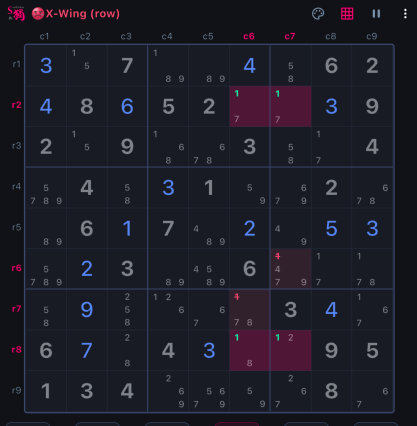
Digit 1 appears as a candidate only at r2c6 and r2c7 in row 2. In row 8, number 1 appears only at r8c6 and r8c7. The candidate columns match: c6 and c7.

That means the number 1 in rows 2 and 8 must occupy those two columns in some order. If row 2 takes column 6, row 8 must take coumn 7. If row 2 takes column 7, row 8 must take column 6. This pattern allows eliminate number 1 from any other cells in both column 6 and column 7, in this case those cells are r6c7 and r7c6.

What to notice: Either way, columns 6 and 7 already receive their number 1 inside the four X-Wing cells. Other cells in those columns cannot contain 6.
Placeholder for an X-Wing walkthrough screenshot

Walkthrough

Example 02 — Column-based X-Wing

The same logic works in the opposite direction. If one number is limited to the same two rows in each of two columns, those two rows become the cover lines and the number can be eliminated from other cells in those rows.

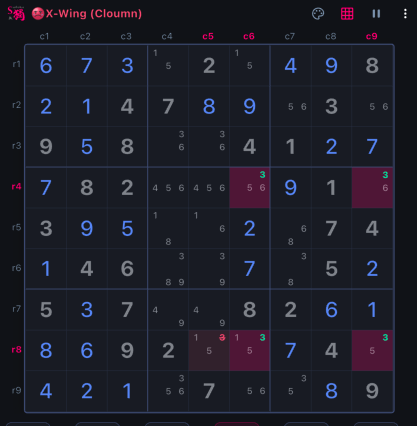
In this example number 3 forms a column based X-Wing with four cells: r4c6, r8c6, r4c9 and r8c9; row 4 and row 8 are cover lines and number 3 can be eliminated from other cells in row 4 and row 8.

What to notice: Rotate the idea rather than memorizing a separate rule. Rows and columns exchange roles.

Placeholder for a column-based X-Wing walkthrough screenshot

How it works

STRONG LINKS MAKE WEAK LINKS STRONG.

The X-Wing does not tell us which diagonal is correct. It tells us that whichever arrangement occurs, the number must occupy diagonally both of the matching lines within the four X-Wing cells. Therefore the number can be removed from every other cell in those perpendicular lines.

01

Find the structure.

Choose one number and find one row (or column) where that number has exactly two candidate cells.

02

Confirm a match.

Find a matching row (or column) where that number also has exactly two candidate cells, and those two cells line up perfectly in the same two perpendicular columns (or rows)

03

Eliminate outside the pattern.

Remove that number from every other candidate cell in the two cover columns(or rows), leaving the four X-Wing corners intact.

FISH 01

A useful reminder

THE FOUR CORNERS ARE NOT THE ELIMINATION.

The X-Wing corners establish the structure. The useful result is what happens outside the rectangle: the number can be removed from other cells in the two perpendicular cover lines. Keep the four defining candidates; eliminate only the matching number elsewhere in those columns or rows.

Watch & learn

Watch live here.

Coming soon...

Practice

LEARN TO SEE THE PAIRING.

When you are stuck, choose one number and list the rows where it appears in exactly two candidate cells. Look for two rows with the same two candidate columns. After every valid elimination, return to Singles, intersections, and subsets before searching for another advanced pattern.