
Advanced technique · Single Digit Pattern · 03

Empty Rectangle

An empty-looking box links a conjugate pair to a single-number elimination.

AdvancedSingle Digit PatternsElimination

The idea

A RESTRICTED BOX CREATES AN INVISIBLE PATH FOR ONE NUMBER.

An Empty Rectangle begins with a box where one number is restricted to exactly one row and one column. The remaining four cells away from that row and column form the Empty Rectangle region.

Pair that structure with a strong link of the same number in a row or column elsewhere on the board, where one end of that strong link must share a row or column with the number inside the box. The intersection cell that sees both the other end of the strong link and the number's row or column inside the box then can be eliminated.

The question: Does one number in a box live on exactly one row and one column, creating an Empty Rectangle?

Walkthroughs

FIND THE BOX, THEN FOLLOW THE ARMS

The key is to identify the restricted box before thinking about the elimination target.

Walkthrough

Example 01 — Mark the Empty Rectangle

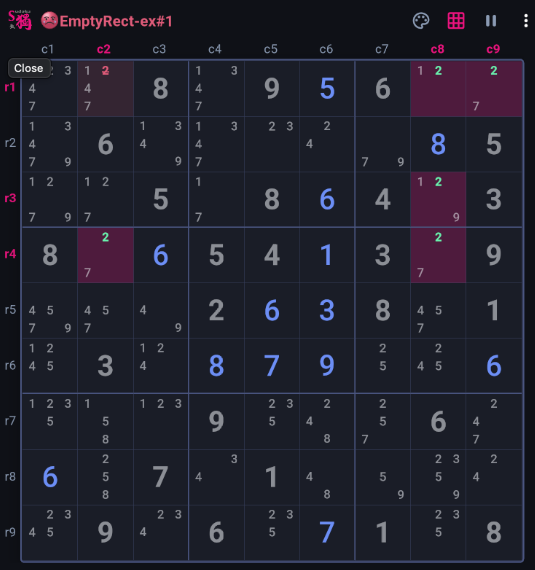
Digit 2 in box 3 can appear only in row 1 or column 8, which form a T pattern where remaining cells are the Empty Rectangle region.

In row 4, there is a conjugate pair for number 2. One end of the pair, cell r4c8, aligns with the rectangle's column 8, while the other end, cell r4c2, can see cell r1c2 with number 2, where cell r1c2 is in the rectangle's row 1. Therefore, number 2 can be eliminated from cell r1c2 as explained below:

If cell r4c2 is not number 2, then cell r4c8 must be number 2, which forces cell r1c9 to be number 2. Therefore regardless what number cell r4c2 takes, cell r1c2 cannot be number 2.

What to notice: The rectangle itself is not the elimination. It is the structure that carries the implication from one arm to the other.
Placeholder for an Empty Rectangle walkthrough screenshot

Walkthrough

Example 02 — Prove the target is impossible

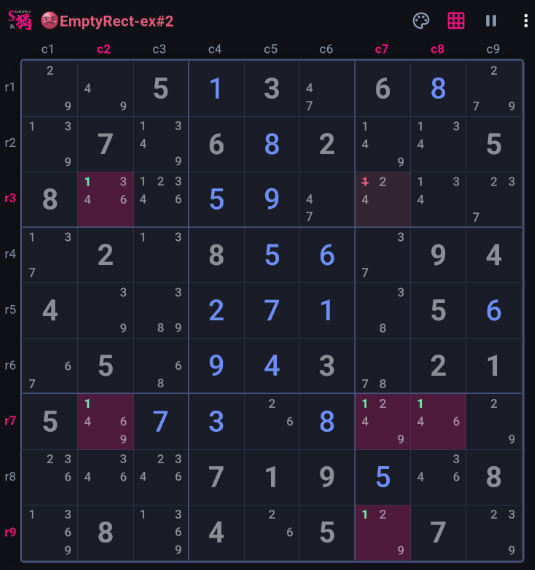
Digit 1 in box 9 can appear only in row 7 and column 7 and forms an L shape, where remaining cells create the Empty Rectangle region.

The conjugate pair of number 1 in column 2 has one end cell r7c2 aligned with the rectangle's row 7, while the other end cell r3c2 sees the target cell r3c7 which aligns with column 7 of the rectangle. Therefore number 1 can be eliminated from cell r3c7.

What to notice: Empty Rectangle is easiest to understand as a two-case proof. Whichever side of the strong link is true, the target is ruled out.

If the first candidate of the conjugate pair is true, the shared row prevents the target candidate. If that first candidate is false, the strong link forces the other candidate, and the box restriction again prevents the target.

Both cases lead to the same result: the target number cannot be placed there.

Placeholder for a second Empty Rectangle proof walkthrough screenshot

How it works

BOTH SIDES OF THE STRONG LINK RULE OUT THE SAME TARGET.

One branch uses a line of the rectangle directly. The other branch uses another line to force one end of the conjugate pair. Because both branches eliminate the target, the candidate can be removed.

01

Find the restricted box.

For one number, find a box where all candidates lie only on one row and one column.

02

Find the strong link.

Look for a conjugate pair whose one end lies on the rectangle's row or column.

03

Eliminate the target.

Use the rectangle's other arm to identify the candidate that both branches rule out.

SDP 03

A useful reminder

THE RECTANGLE IS A ROUTE, NOT A REGION TO FILL.

When you see an Empty Rectangle, do not look for a hidden number inside it. Use the row and column restriction to carry the logic from a strong link to the elimination target.

Watch & learn

Watch live here.

Coming soon...

Practice

START WITH BOX RESTRICTIONS.

Choose a number and inspect each box. If its candidates occupy only one row and one column, mark that box as an Empty Rectangle candidate. Then search the aligned rows and columns for a conjugate pair that can complete the pattern.