Advanced technique · Single Digit Pattern · 01

Skyscraper

Two strong links. One shared base. A forced single-number elimination.

AdvancedSingle Digit PatternsElimination

The idea

TWO STRONG LINKS SHARE A BASE AND FORCE THE OTHER END TO BE TRUE.

A Skyscraper uses one number and two conjugate pairs. Each pair forms a strong link in a row or column with that number, and one cell from each pair lies in the same column or row. Those two cells from each pair form the base, and the other two cells from each pair form the top.

If one top is false for that number, the strong link forces its base partner to be true for the number. The link at the base then forces the other top cell to be true for the number. Therefore at least one of the two top cells must be true for the number.

Elimination: any cell that sees both the top cells cannot be that number.

The question: Can two strong links for one number share a base row or column?

Walkthroughs

FOLLOW THE TWO STRONG LINKS

Find one number that appears exactly twice in each of two rows or columns. Then check whether one cell from each pair shares a column or row.

Walkthrough

Example 01 — Row based Skyscraper

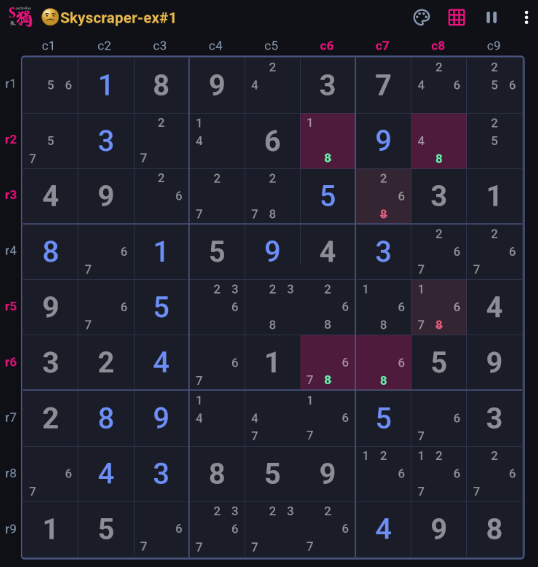
Digit 8 forms two row based conjugate pairs: one pair on row 2 with cells r2c6 and r2c8, and another pair on row 6 with cells r6c6 and r6c7. Both pairs share column 6 which forms the base.

If r2c8 is not number 8, then r2c6 must be 8. But then r6c6 cannot be 8, so r6c7 must be 8. The reverse argument works from r6c7.

Therefore one of r2c8 or r6c7 must be 8. Any cell that sees both of them can eliminate number 8.

What to notice: The pattern is about the cell relationships, not the visual height of the shape.
Placeholder for a Skyscraper walkthrough screenshot

Walkthrough

Example 02 — Column based Skyscraper

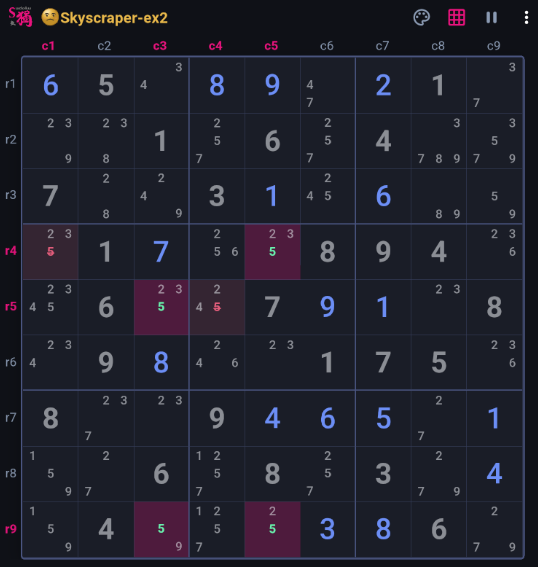
This examples shows two column based conjugate pairs on number 5, one pair is in column 3 with cells r5c3 and r9c3, another pair is in column 5 with cells r4c5 and r9c5. The two pairs share the same row r9 which is the base. Any cell that see the both top cells r5c3 and r4c5 can have number 5 eliminated.

What to notice: The final move is always an elimination. The skyscraper proves that at least one of the two ends contains the number.

After identifying the two top ends, stop looking at the whole grid. Look only for cells that see both ends and still contain the number as a candidate.

Those cells are the elimination zone. Remove the number there, but do not remove it from cells that see only one end.

Placeholder for a second Skyscraper elimination-zone walkthrough screenshot

How it works

ONE OF THE TWO TOP ENDS MUST CONTAIN THE NUMBER.

The two strong links guarantee that if either top candidate is false, the other top candidate is forced to be true through the base. So the two ends cannot both be false.

01

Find two strong links.

For one number, find two rows or columns where the number has exactly two candidates.

02

Connect the base.

One cell from each pair must share a row or column. Those two cells form the base.

03

Eliminate from both ends.

Any candidate cell that sees both top cells cannot contain the number.

SDP 01

A useful reminder

THE BASE CONNECTS THE STRONG LINKS; THE TOPS CREATE THE ELIMINATION.

When scanning for a Skyscraper, identify the two conjugate pairs first. The shared base row or column is what turns them into a usable pattern.

Watch & learn

SEE SKYSCRAPER IN ACTION.

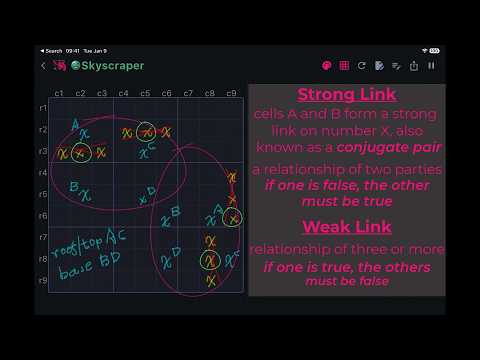
Walk through a puzzle to find a Skyscraper patterns. Along the way, learn a few key concepts used in chain related techniques: strong links, weak links, and conjugate pairs.

Preview of the Skyscraper Sudoku lesson Watch on YouTube Skyscraper · Video lesson ↗

Practice

TRACE ONE NUMBER AT A TIME.

Pick a number and scan rows or columns that contain exactly two candidates. When two strong links share a base, mark the two outer ends and check what cells see both. After an elimination, return to Singles, intersections, and subsets.