Advanced technique · Single Digit Pattern · 02

Two-String Kite

A row and a column connect through one box to force an elimination.

AdvancedSingle Digit PatternsElimination

The idea

TWO STRONG LINKS CONNECT THROUGH A BOX.

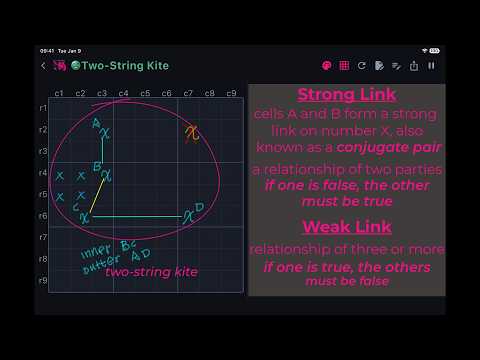
A Two-String Kite uses one number in exact two cells of one row and exact two different cells of one column. One cell from the row and one from the column are in the same box.

That box connection creates a four-cell pattern. One of the two outer cells out of the box must be true, so any cell that sees both outer cells cannot contain the number.

The question: Can a row and a column conjugate pairs connect through the same box?

Walkthroughs

CONNECT THE ROW AND COLUMN

Look for a conjugate pair in a row and another conjugate pair in a column. Then check whether two cells, one from each pair, share a box.

Walkthrough

Example 01 — The kite connection

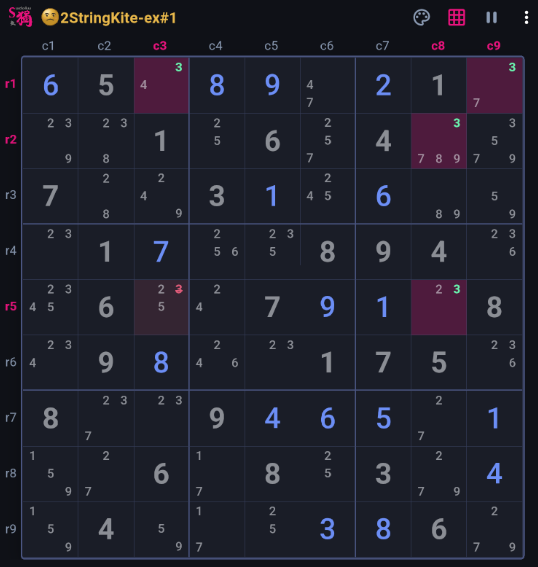
Digit 3 appears only at cells r1c3 and r1c9 in row 1, and only at cells r2c8 and r5c8 in column 8. The cells r1c9 and r2c8 lie in the same box 3.

If cell r1c3 is not 3, then cell r1c9 must be 3. That blocks cell r2c8, so cell r5c8 must be 3. The reverse direction gives the same conclusion: if cell r5c8 is not 3, then cell r2c8 must be 3. That blocks cell r1c9, so cell r1c3 must be 3. Therefore one of cells r1c3 and r5c8 must be 3.

A cell that sees both cells r1c3 and r5c8 can therefore eliminate 3, in this case, cell r5c3.

What to notice: The shared box is the bridge. Without that connection, the two strong links do not form a kite.
Placeholder for a Two-String Kite walkthrough screenshot

Walkthrough

Example 02 — The target cell

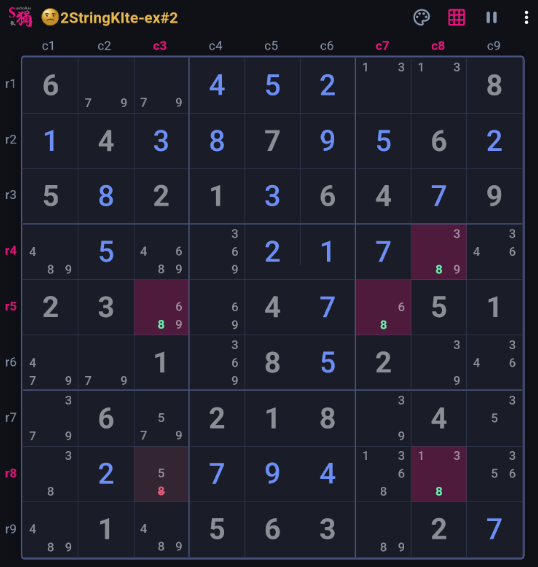
Digit 8 forms two conjugate pairs, one in row r5 with cells r5c3 and r5c7, another in column 8 with cells r4c8 and r8c8. Cell r5c7 of the row based conjugate pair meets cell r4c8 of the column based conjugate pair in box 6, whch forms a Two String Kite. Therefore, number 8 can be eliminated from the cell r8c3, which sees both cells r5c3 and r8c8 that are out of the box 6.

What to notice: Separate the bridge from the target. The box proves the relationship; the shared visibility of the outer ends creates the elimination.

Once the kite is identified, locate cells that see both outer ends and still contain the kite number. Those cells are the only valid elimination targets.

A cell can be visually close to the pattern and still be unaffected if it sees only one end.

Placeholder for a second Two-String Kite walkthrough screenshot

How it works

THE BOX BRIDGE TURNS TWO STRONG LINKS INTO ONE CHAIN.

The row pair and column pair each guarantee one of their candidates. The two cells inside the shared box cannot both be true, so the force travels across the box and reaches the opposite ends.

01

Find the row string.

For one number, find a row with exactly two cells.

02

Find the column string.

Find a column with exactly two cells, with one cell sharing a box with one cell of the row string.

03

Eliminate from the two ends.

Any cell that sees both outer ends cannot contain the number.

SDP 02

A useful reminder

THE KITE NEEDS ONE ROW, ONE COLUMN, AND ONE SHARED BOX.

Do not search for the shape first. Search for two seperated strong links on the same number, then test whether the row and column can be connected through a box.

Watch & learn

SEE TWO-STRING KITE IN ACTION.

Walk through a few puzzles to find Two-String Kite patterns. Along the way, learn a few key concepts used in chain related techniques: strong links, weak links, and conjugate pairs.

Preview of the Sudoku lesson Watch on YouTube Two-String Kite · Video lesson ↗

Practice

START WITH CONJUGATE PAIRS.

Choose one number and scan for rows and columns with exactly two cells. Mark possible row-column pairs that meet in a box, then search for a common target seen by the two outer ends. After an elimination, return to Singles, intersections, and subsets.