
Advanced technique · Uniqueness · 06

Avoidable Rectangle

Placed cells can expose a rectangle that would otherwise create a second solution.

AdvancedUniquenessElimination

The idea

A RECTANGLE CAN BECOME DEADLY AS CELLS ARE PLACED.

An Avoidable Rectangle is related to a Unique Rectangle, but some of its corner cells are already solved (excluding pre-filled). If the remaining unsolved cells were filled in a way that completed the deadly two-number rectangle, the placed cells would not have been sufficient to guarantee a unique solution. The important condition is that the rectangle's placed cells are not original givens; they arose during the solve.

The question: Could the current placements be completed into a deadly rectangle?

Walkthroughs

CHECK WHETHER THE PLACED CELLS ARE REVERSIBLE

Start with the rectangle structure involing at least two or three already solved cells(not prefilled), then verify the uniqueness condition before making the elimination.

Walkthrough

Example 01 — Avoidable Rectangle Type 1

Three corner cells, r1c2, r3c2 and r3c9, of a potential rectangle have already been solved to numbers 4 and 5, the remaining cell r1c9 can take either number 4 or number 5. Placing number 4 in cell r1c9 would complete a two-solution rectangle, therefore number 4 can be removed from cell r1c9.

What to notice: Avoidable Rectangle is about the history of the placements as well as the current candidate pattern.

The reasoning depends on the placed cells being solved rather than originally givens. If one of the rectangle cells was an original given, swapping the rectangle numbers would no longer produce the same puzzle.
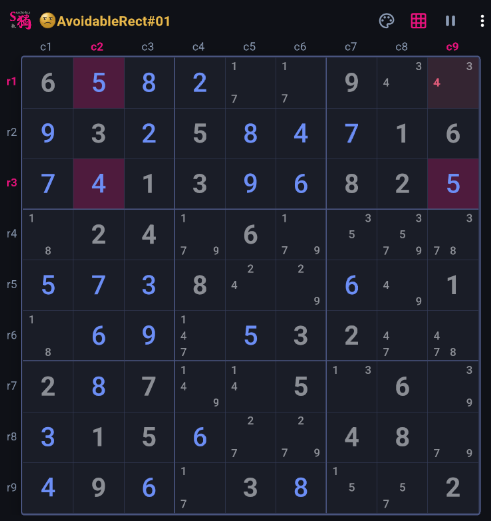
Placeholder for a Avoidable Rectangle walkthrough screenshot

Walkthrough

Example 02 — Avoidable Rectangle Type 1

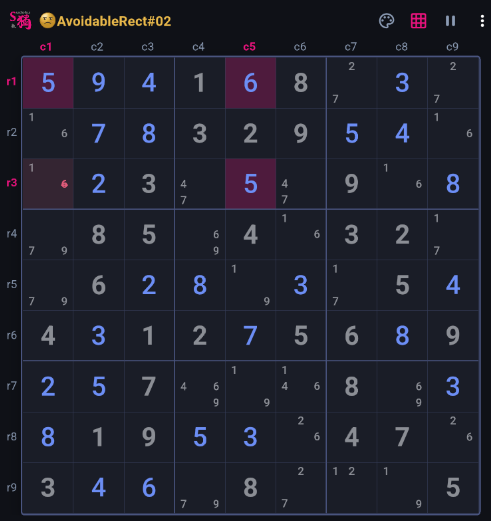
Three corner cells, r1c1, r1c5 and r3c5, of a potential rectangle have already been solved to numbers 5 and 6, the remaining cell r3c1 can take either number 1 or number 6. Placing number 6 in cell r3c1 would complete a two-solution rectangle, therefore number 6 can be removed from cell r3c1.

What to notice: The rectangle logic remains familiar; the key difference is that some corners are already filled.

Placeholder for a Avoidable Rectangle walkthrough screenshot

How it works

THE PLACED CELLS MUST NOT HAVE BEEN ORIGINAL GIVENS.

Avoidable Rectangle logic works because the current placements could have been different. If all four rectangle corners were solved in a symmetrical way, a swap could create a second solution. If any corner is an original given, that swap is no longer available, so the uniqueness argument changes.

01

Find the rectangle.

Identify the two rows, two columns, two boxes, and rectangle numbers with two or three solved cells.

02

Check the placement history.

Make sure the placed rectangle cells were not original givens.

03

Apply the appropriate AR rule.

Use the remaining candidates to eliminate the move that would create a symmetrical placement which completes the deadly rectangle.

UR 06

A useful reminder

PLACEMENT HISTORY MATTERS HERE.

An Avoidable Rectangle is not simply a Unique Rectangle with unsolved cells; and solved cells must not be originally given, because the uniqueness proof depends on the possibility that those placements could have been different.

Watch & learn

Watch live here.

Coming soon...

Practice

CHECK THE GRID HISTORY

When you spot a potential rectangle with solved corners, first distinguish original givens from later placements. Then test whether completing the rectangle would create the forbidden two-solution pattern.