
Advanced technique · Uniqueness · 07

BUG+1

One exceptional cell breaks an otherwise complete bivalue grave.

AdvancedUniquenessElimination

The idea

ONE EXTRA CANDIDATE PREVENTS A COMPLETE BUG.

A BUG+1 is an almost-complete Binary Universal Grave. Every unsolved cell has exactly two candidates except one cell, which has one additional candidate. In a true BUG, every candidate would appear exactly twice in every relevant row, column, and box, creating more than one solution. The extra candidate in the exceptional cell is therefore forced.

The question: Is the whole grid one extra candidate away from a BUG?

Walkthroughs

VERIFY THE BUG CONDITIONS BEFORE PLACING ANYTHING

Start with the BUG structure, then verify one cell with three numbers that can break the BUG before making the elimination.

Walkthrough

Example 01 — Find the exceptional cell

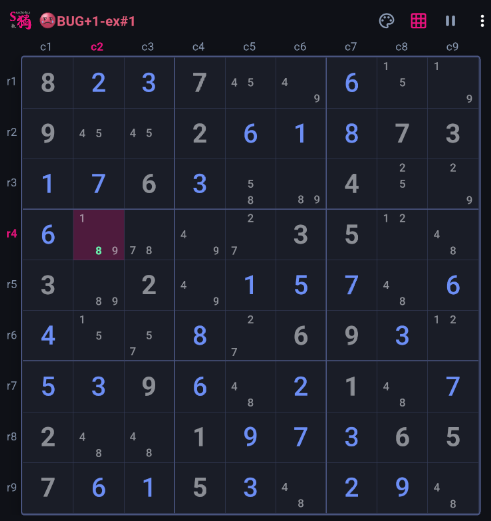
Every unsolved cell is bivalue except cell r4c2, which has numbers 1, 8 and 9. Removing number 8 would leave every candidate appearing exactly twice in each row, column, and box, the grid would become a BUG.

Because the puzzle is assumed to have one solution, cell r4c2 must be number 8. Equivalently, numbers 1 and 9 can be eliminated from that cell.

What to notice: BUG+1 is only valid when the rest of the grid really satisfies the BUG counting condition.
Placeholder for a BUG+1 walkthrough screenshot

Walkthrough

Example 02 — A near-BUG is not enough

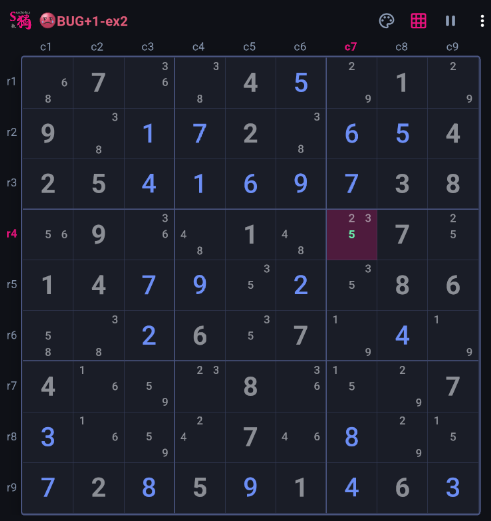
A similar situation here where cell r4c7 must be 5 to avoid a BUG+1.

What to notice: It is not enough to see many bivalue cells and one cell with three candidates. Check the candidate counts throughout every row, column, and box.

If another candidate appears three times or only once where the BUG condition requires twice, you do not have a valid BUG+1. Stop and look for another technique.

Placeholder for a second BUG+1 walkthrough screenshot

How it works

REMOVING THE EXTRA CANDIDATE WOULD CREATE A TWO-SOLUTION BUG.

A complete BUG has all unsolved cells bivalue and every candidate occurring exactly twice in each row, column, and box. BUG+1 differs in exactly one place. The extra candidate is the candidate that breaks that deadly structure, so it must be the correct value in the exceptional cell.

01

Check the whole grid.

All unsolved cells must have exactly two candidates, except one that has three.

02

Verify the counts.

Each candidate must occur exactly twice in every row, column, and box once the exceptional extra is removed.

03

Place the extra candidate.

The additional candidate in the exceptional cell is forced.

BUG + 1

A useful reminder

BUG+1 IS A WHOLE-GRID PATTERN.

Do not recognize BUG+1 from the exceptional cell alone. The entire remaining candidate state must satisfy the BUG condition.

Watch & learn

Watch live here.

Coming soon...

Practice

VERIFY BEFORE YOU TRUST THE PATTERN

When a grid becomes almost entirely bivalue, check every unit for the exact BUG counts. If there is exactly one exceptional cell and one extra candidate, BUG+1 can finish that branch of the puzzle quickly.