
Advanced technique · Uniqueness · 05

Hidden Rectangle

A deadly rectangle can be hidden underneath extra candidates.

AdvancedUniquenessElimination

The idea

THE RECTANGLE IS THERE, BUT EXTRA CANDIDATES HIDE ITS SHAPE.

A Hidden Rectangle is a uniqueness pattern where the four rectangle cells are obscured by additional candidates. The key is to identify the two rectangle numbers and the four-cell geometry with at least one corner is a strict bivalue cell holding the two numbers that form the rectangle, even though other cells contain many other candidates; Look for strong links for one of the numbers across the rows and columns of the rectangle, and the other number occupied a specific cell could force a deadly rectangle.

The question: Can two numbers be restricted to a four-cell rectangle even though other candidates are cluttering those cells?

Walkthroughs

UNCOVER THE RECTANGLE UNDER THE CANDIDATE CLUTTER

Focus on a bivalue cell and look around it to find other three corners, then verify if the diagonal cell has one of the rectangle numbers form strong links with the other two corner cells .

Walkthrough

Example 01 — Find the hidden pair of numbers

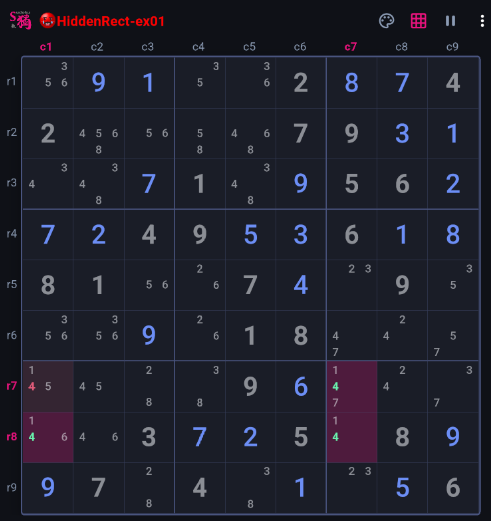
Bivalue cell r8c7 contains two numbers 1 and 4, three other cells r7c1, r7c7 and r8c1 contain numbers 1 and 4 plus extras, they form a Hidden Rectangle. Meanwhile, Cell r7c1 forms two strong links on number 1 with two corner cells r7c7 and r8c1. if cell r7c1 took number 4, it would force cells r7c7 and r8c1 to be number 1, resulting cell r8c7 to be number 4, this would be a deadly rectangle.

   4   1
   1   4

Therefore number 4 can be eliminated from cell r7c1.

What to notice: The challenge is recognition. The rectangle is defined by the candidate relationship, not by the number of candidates written in each cell.
Placeholder for a Hidden Rectangle walkthrough screenshot

Walkthrough

Example 02 — Verify the hidden structure

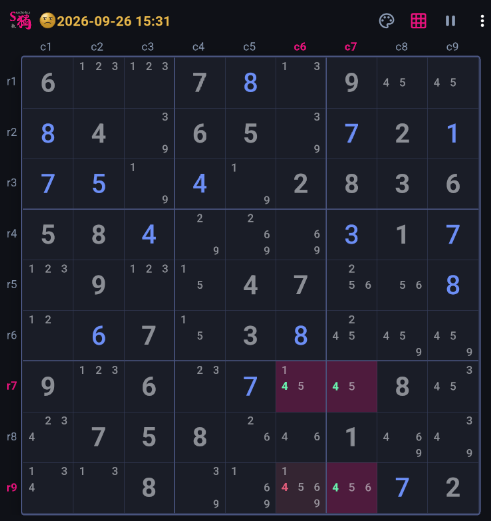
Bivalue cell r7c7 of numbers 4 and 5 along with cells r7c6, r9c6 and r9c7 form a Hidden Rectangle with extra numbers 1, 6 and 9. The diagonal cell r9c6 has strong links with two corner cells r7c6 and r9c7 on number 5, therefore number 4 can be removed from that cell.

What to notice: Hidden Rectangle is more about seeing through clutter than memorizing a new proof.

Trace each of the two rectangle numbers through the four cells. Confirm that the candidate pair is not blocked by a given and that the four cells occupy exactly two rows, two columns, and two boxes.

Then identify the diagonal cell where the strong links prevent the deadly rectangle. Apply the appropriate uniqueness elimination only after the hidden structure is proved.

Placeholder for a second Hidden Rectangle walkthrough screenshot

How it works

EXTRA CANDIDATES CAN HIDE A DEADLY RECTANGLE.

The uniqueness argument still depends on the same four-cell, two-number structure. Additional candidates can obscure it, but if the two numbers could still form the deadly rectangle, the puzzle must prevent that outcome. The resulting elimination depends on how the strong links are formed.

01

Choose a bivalue cell.

Trace the candidate pair and find the four corners of a rectangle, even with extra numbers.

02

Confirm the strong links.

The diagonal cell must have strong links on one of rectangle numbers with two corners.

03

Apply the uniqueness proof.

The other rectangle number can be removed from the diagonal cell.

UR 05

A useful reminder

HIDDEN DOES NOT MEAN DIFFERENT.

The underlying uniqueness relationship is the same. What changes is the amount of candidate clutter hiding it and strong links inside.

Watch & learn

Watch live here.

Coming soon...

Practice

TRACE BIVALUE CELLS THROUGH THE GRID

Pick a bivalue cell and look for four cells that could form the two-row, two-column, two-box rectangle. Do not require other three cells to be bivalue; first see whether the rectangle is hidden inside their candidate lists, then check strong links.