
Advanced technique · Uniqueness · 01

Unique Rectangle Type 1

One extra candidate breaks a deadly configuration.

AdvancedUniquenessElimination

The idea

ONE EXTRA CANDIDATE KEEPS THE RECTANGLE FROM BECOMING DEADLY.

A Unique Rectangle Type 1 starts with four cells occupying exactly two rows, two columns, and two boxes. Three of those cells are limited to the same two candidates; the fourth has those two candidates plus an extra candidate. If the two rectangle candidates remained in that fourth cell, the two numbers could be exchanged around the rectangle and create two solutions. The extra candidate therefore has to remain, so the rectangle candidates can be eliminated from that cell.

The question: Can three corners support the same two numbers while one corner has an extra candidate?

Walkthroughs

FIND THE FOUR CORNERS AND THE ONE EXCEPTION

Start with the rectangle structure, then verify the one-corner extras condition before making the elimination.

Walkthrough

Example 01 — The extra candidate

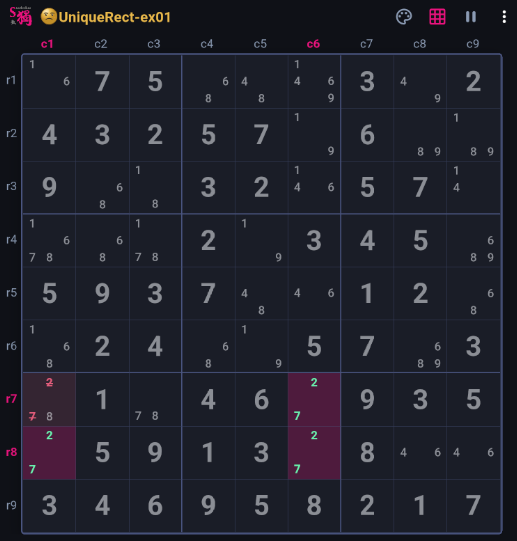
A rectangle uses numbers 2 and 7. Three corners r7c6, r8c1 and r8c6 are restricted to numbers 2 and 7, while cell r7c1 contains numbers 2, 7 and 8. If number 8 was removed from r7c1, the four cells could resolve as two different 2/7 arrangements. That would violate the puzzle's uniqueness assumption.

Therefore cell r7c1 must keep number 8, removing 2 and 7 from cell r7c1. Since number 8 is the only extra candidate, cell r7c1 is immediately solved as number 8.

What to notice: Before applying the move, verify the four cells occupy exactly two rows, two columns, and two boxes. The four corners must form the rectangle across two boxes; a shape that misses one of those structural requirements is not a Unique Rectangle.

Once the geometry is confirmed, identify the two rectangle numbers and the single extra candidate. The elimination belongs only in the exceptional cell.
Placeholder for a Unique Rectangle Type 1 walkthrough screenshot

Walkthrough

Example 02 — Check the rectangle geometry

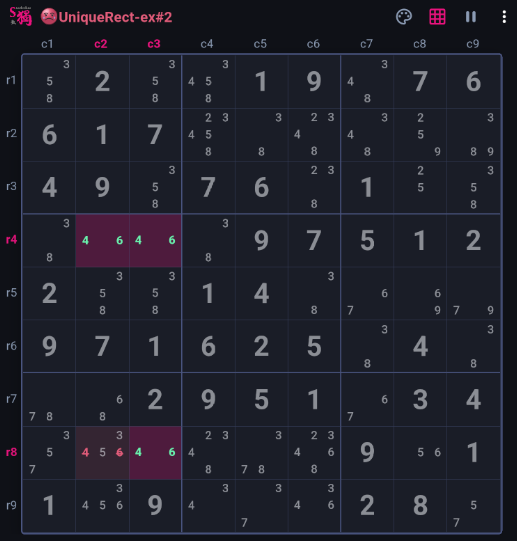
A rectangle' three corners r4c2, r4c3 and r8c3 are restricted to numbers 4 and 6, while the fourth cell r8c2 contains two extra numbers 3 and 5. If both numbers 3 and 5 were removed from r8c2, the four cells could resolve as a deadly 4/6 arrangements.

Therefore cell r8c2 must keep numbers 3 and 5 and remove numbers 4 and 6 to avoid multiple solutions.

What to notice: The rectangle patten is the key, a fourth cell does not need to be solved immediately. The uniqueness proof simply tells which candidates cannot remain there.

Placeholder for a second Unique Rectangle Type 1 walkthrough screenshot

How it works

WITHOUT THE EXTRA CANDIDATE, THE RECTANGLE COULD HAVE TWO SOLUTIONS.

If the fourth cell were also limited to the rectangle pair, the four cells could swap the two numbers while still respecting their rows, columns, and boxes. The single-solution assumption rules out that state, so the exceptional cell must take something outside the pair.

01

Find the rectangle.

Choose four cells in exactly two rows, two columns, and two boxes.

02

Find the exception.

Three corners contain only the same two candidates; the fourth contains those candidates plus at least one extra.

03

Eliminate the pair.

Remove the same two rectangle candidates from the exceptional cell, keep extras.

UR 01

A useful reminder

THE EXTRA CANDIDATE IS WHAT SAVES THE PUZZLE.

Do not start by asking which number goes in a corner. Start by asking what would happen if the rectangle pair were the only candidates in all four corners.

Watch & learn

Watch live here.

Coming soon...

Practice

SCAN FOR FOUR-CELL RECTANGLES

Look for the same two candidate numbers appearing across four cells in two rows, two columns, and two boxes. Then check whether exactly one corner has additional candidates. After an elimination, return to Singles, intersections, and subsets.