
Advanced technique · Uniqueness · 03

Unique Rectangle Type 3

Extra candidates combine with a subset to force eliminations.

AdvancedUniquenessElimination

The idea

THE RECTANGLE CREATES A VIRTUAL SUBSET.

A Unique Rectangle Type 3 uses two non-diagonal rectangle cells with extra candidates. Because at least one of those extra candidates must be true to prevent the deadly rectangle, the two cells can be treated together as a virtual cell containing only their extra candidates. If those candidates then form a Naked or Locked Subset with other cells in a same house, they can be eliminated from the remaining cells in that house.

The question: Can the extra candidates from the rectangle combine with a subset?

Walkthroughs

TURN THE RECTANGLE INTO A SUBSET

Start with the rectangle structure, then verify if combining extras with other cells in the same house create a Subset before making the elimination.

Walkthrough

Example 01 — Build the virtual cell

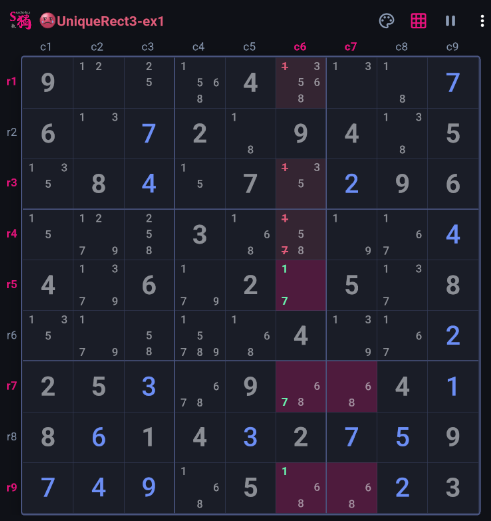
The rectangle pair is numbers 6 and 8, the non-diagonal corner cell r7c6 has an extra number 7, the other corner cell r9c6 has extra number 1. Because one of the extras must be used to avoid the deadly rectangle, the two cells can be considered together as one virtual cell with numbers 1 and 7.

Cell r5c6 has numbers 1 and 7, combined with the virtual cell, they form a Subset, in this case a Naked Pair in column 6. Therefore numbers 1 and 7 can be removed from other cells in column 6.

What to notice: The rectangle supplies the missing subset logic. You are not treating the two cells as literally one cell; you are using them as a combined candidate set for the proof.
Placeholder for a Unique Rectangle Type 3 walkthrough screenshot

Walkthrough

Example 02 — Apply the subset elimination

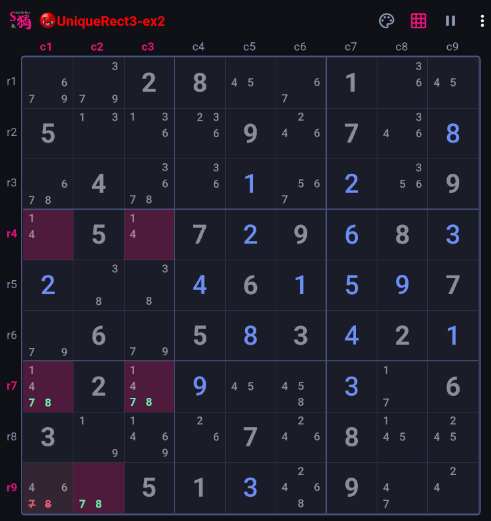
Similarly, the roof cells r7c1 and r7c3 with numbers 7 and 8 form a virtual cell, together with cell r9c2 inside box 7, they form a Naked Pair. therefore numbers 7 and 8 can be removed from any cell inside box 7.

What to notice: Type 3 is a bridge between uniqueness and subset reasoning.

After building the combined candidate set, check whether it participates in a Naked or Locked Pair, Triple, or another valid subset structure.

If the subset is valid, remove its candidates from cells outside the subset but inside the same relevant house. The uniqueness condition is what allows the rectangle cells to contribute as a single virtual unit.

Placeholder for a second Unique Rectangle Type 3 walkthrough screenshot

How it works

THE RECTANGLE GUARANTEES THAT AN EXTRA CANDIDATE MUST SURVIVE.

The two exceptional rectangle cells cannot both lose all of their extra candidates, or the deadly rectangle would appear. That lets us combine their extra candidates and test them as a virtual subset. If the subset locks those candidates into a defined set of cells, normal subset elimination finishes the move.

01

Find the rectangle.

Locate the two non-diagonal corners with extra candidates.

02

Combine the extras.

Treat the extra candidates from those corners as one virtual candidate set.

03

Find the subset.

If that set forms a Naked or Locked SubSet with other cells in a house, eliminate extra candidates from the rest of the house.

UR 03

A useful reminder

THINK OF TYPE 3 AS UR + SUBSET.

The rectangle supplies the uniqueness constraint; the subset supplies the actual elimination. Keeping those two pieces separate makes the pattern much easier to verify.

Watch & learn

Watch live here.

Coming soon...

Practice

LOOK FOR SUBSETS AFTER FINDING THE RECTANGLE

Do not force a Type 3. First identify a valid possible rectangle with two exceptional corners. Then ask whether their extra candidates naturally form a subset in a shared house.