
Advanced technique · Uniqueness · 04

Unique Rectangle Type 4

A strong placement of one rectangle number forces the other number out.

AdvancedUniquenessElimination

The idea

ONE NUMBER HAS NOWHERE ELSE TO GO IN A HOUSE.

A Unique Rectangle Type 4 again has two non-diagonal corners with extra candidates, but instead of focusing on the extras, focus on the two rectangle numbers. If one number has no other possible location in a house that contains both exceptional corners, that number must occupy one of those corners. The other rectangle number can then be eliminated from both corners, because allowing both would recreate the deadly rectangle.

The question: Does one rectangle number have only the two exceptional corners left in a house?

Walkthroughs

USE THE HOUSE TO FORCE ONE RECTANGLE NUMBER

Start with the rectangle structure, then verify if one number is forced in a house before making the elimination.

Walkthrough

Example 01 — One number is locked to a box

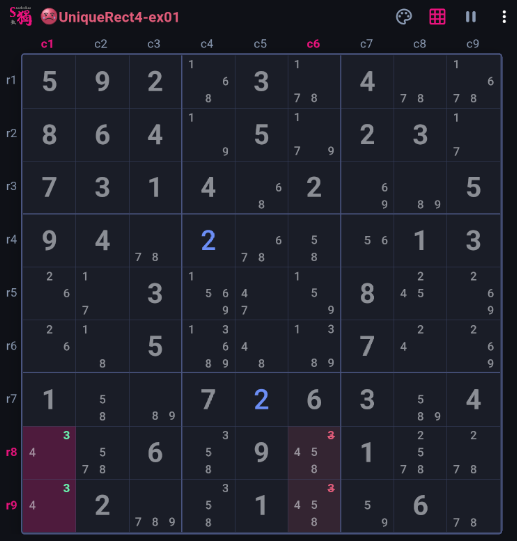
The rectangle numbers are 3 and 4. The two exceptional corners r8c6 and r9c6 share column 6, number 4 appears nowhere else in column 6. Therefore 4 must occupy one of those two corners.

If cell r8c6 were number 3, then number 4 would be pushed into cell r9c6, in turn, cell r8c1 would be 4, and cell r9c1 would be 3, now it would end up with a deadly pattern of four corners' values liking this:

   4   3
   3   4

you could swap left and right cornor pairs, or above and below cornor pairs, while the rest of the soduku grid would still be perfeectly valid.

Similarly, if cell r9c6 were number 3, it would end up with the same deadly pattern. Therefore, both cells r8c6 and r9c6 cannot be number 3.

What to notice: The house restriction proves one rectangle number must be present; uniqueness then eliminates the other number.
Placeholder for a Unique Rectangle Type 4 walkthrough screenshot

Walkthrough

Example 02 — Check all shared houses

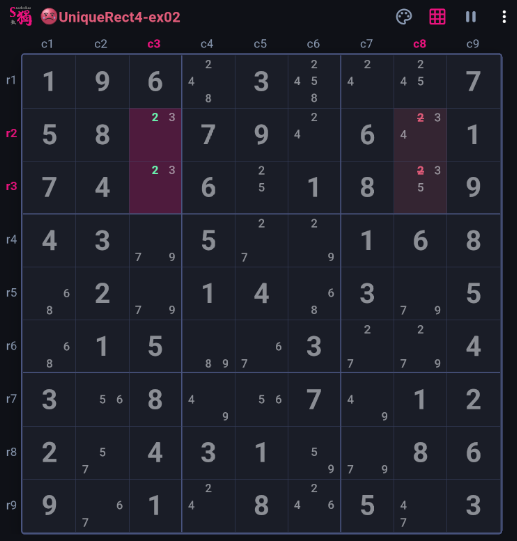
Similarly, in this example number 3 is forced in column 8 (or box 3), so number 2 can be eliminated from two rectangle cornor cells in column 8.

What to notice: Two exceptional corners can share more than one house, such as a row and a box or a column and a box. You only need one of those houses to contain the required strong placement condition.

If a rectangle number has no other possible location in that house, it must occupy one of the two exceptional cells. That is enough to trigger the uniqueness elimination.

You are not looking for a new candidate pattern; you are proving that one of the existing rectangle numbers is forced into the pair.

Placeholder for a second Unique Rectangle Type 4 walkthrough screenshot

How it works

IF ONE RECTANGLE NUMBER MUST BE IN THE PAIR, THE OTHER CANNOT COMPLETE THE DEADLY PATTERN.

The shared house gives one rectangle number a forced home among the two exceptional cells. Once that number is guaranteed to appear in the pair, placing the other rectangle number in either cell would allow the deadly two-number rectangle to form. Therefore the other number can be eliminated from those cells.

01

Find the exceptional pair.

Locate an rectangle having two non-diagonal rectangle corners with extra candidates.

02

Check a shared house.

Look for a rectangle number that appears nowhere else in a house containing both cells.

03

Eliminate the other number.

Remove the other rectangle candidate from the two exceptional cells.

UR 04

A useful reminder

TYPE 4 LOOKS AT WHERE THE RECTANGLE NUMBERS CAN GO.

The extra candidates are not the main focus. Prove that one rectangle number is forced into the exceptional pair, then use uniqueness to remove the other.

Watch & learn

Watch live here.

Coming soon...

Practice

CHECK THE SHARED HOUSE FOR A SINGLE NUMBER

When two non-diagonal rectangle corners have extras, inspect the row, column, and box they share. If one rectangle number has no other home there, test the Type 4 elimination.