
Advanced technique · Wings · 03

W-Wing

Two matching bivalue cells connected through a strong link.

AdvancedWingsElimination

The idea

TWO IDENTICAL BIVALUE CELLS ARE TIED TOGETHER THROUGH A CONJUGATE PAIR.

A W-Wing uses two bivalue cells(endpoints) with the same number pair {X,Y}. The two cells do not see each other, but they are connected indirectly by a strong link on number X. Each bi-value cell only sees one or the other end of that strong link respectively. This allows eliminate the other number Y from any cells that see both bivalue cells.

The question: Can two identical bivalue cells be connected through a strong link on one of their candidates?

Walkthroughs

TWO IDENTIAL BIVALUE CELLS IN TWO SEPERATE HOUSES

Two bivalue cells must not see each other but are connected through a conjugate pair.

Walkthrough

Example 01 — W-Wing

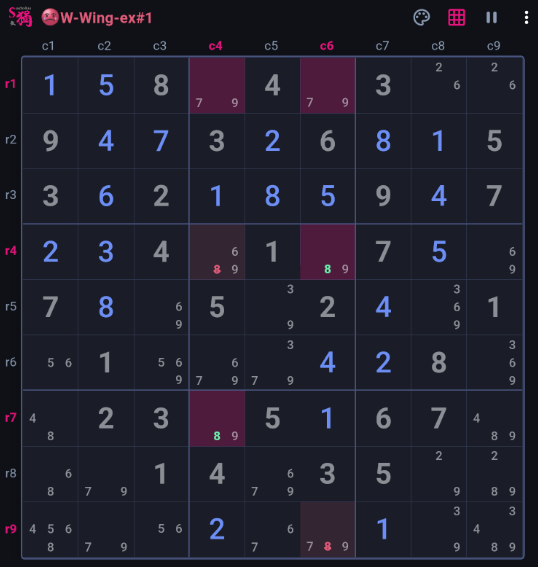
Identical bivalue cells r4c6 and r7c4 contain numbers 8 and 9; they do not see each other but are connected by the conjugate pair r1c4 and r1c6 through number 9. Bivalue cell r4c6 only sees one end of the strong link cell r1c6, while bivalue cell r7c4 only sees the other end of the strong link cell r1c4. This allows eliminate the other number 8 from any cell that sees both the bivalue cells, in this case, cells r4c4 and r9c6, as the following explained:

If cell r4c6 is number 8, both cells r4c4 and r9c6 cannot be number 8 because both of them see cell r4c6.

if cell r4c6 is number 9 instead, then one end of the connecting conjugate pair, which is cell r1c6 in this case, cannot be 9, then the other end of the conjugate pair cell r1c4 must be dight 9, which then forces the other bivalue cell r7c4 to be number 8. Because both cells r4c4 and r9c6 also see cell r7c4, so they cannot have number 8
Placeholder for a W-Wing strong-link walkthrough screenshot

Walkthrough

Example 02 — W-Wing

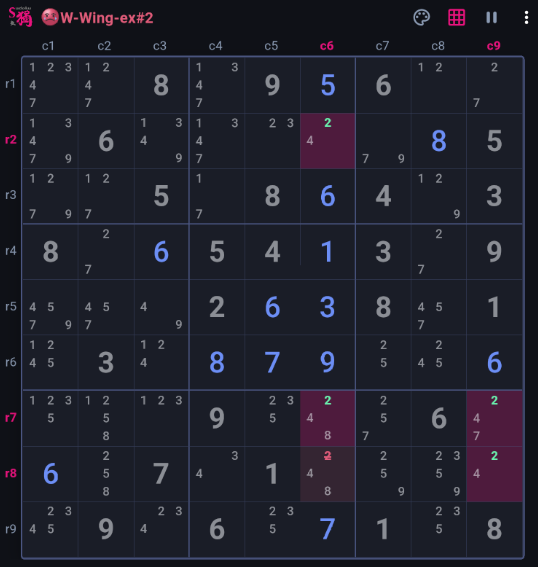
In this example, bivalue cells are r2c6 and r8c9 with numbers 2 and 4; the strong link is cells r7c6 and r7c9 with number 4, this leads to number 2 to be eliminated from cell r8c6, which sees both bivalue cells(endpoints).

What to notice: W-Wings do not have to look like a literal W on the grid. The important structure is two identical bivalue endpoints plus a strong link on one candidate connecting the two sides.

Mark the strong link clearly, then follow the two cases. If the first endpoint takes X, the opposite end of the strong link is forced to X and the second endpoint is forced to Y. If the first endpoint is already Y, the conclusion is immediate.

Only after the proof is complete should you look for cells that see both endpoints and remove Y.

Placeholder for a second W-Wing proof walkthrough screenshot

How it works

THE STRONG LINK CONNECTS THE TWO ENDS OF THE LOGIC.

Suppose the two endpoints are A={X,Y} and B={X,Y}. Let P and Q be the two ends of a strong link on X, with A seeing P and B seeing Q. If A is X, P cannot be X, so the strong link forces Q to X; B then cannot be X and must be Y. If A is not X, A is already Y. Therefore at least one of A or B is Y, so Y can be eliminated from any cell that sees both endpoints.

01

Find matching endpoints.

Look for two separated bivalue cells with the same pair {X,Y}. They must not see each other.

02

Find the strong link.

Choose one candidate, X, and find a conjugate pair for X. Each endpoint of the bivalue cells must see a different end of that strong link.

03

Eliminate Y.

Because at least one matching endpoint must be Y, remove Y from any cell that sees both endpoints.

WINGS 03

A useful reminder

THE W-WING DEPENDS ON A STRONG LINK, NOT JUST TWO MATCHING PAIRS.

Two identical bivalue cells by themselves are not a W-Wing. The strong link is what connects the two possibilities and creates the forced Y relationship. Without that link, the elimination is not justified.

Watch & learn

Watch live here.

Coming soon...

Practice

LOOK FOR REPEATED BIVALUE PAIRS, THEN TRACE A STRONG LINK.

When many bivalue cells are present, look for the same pair appearing in two separated cells which do not see each other. Pick one number from the pair and search for a conjugate pair that connects the two endpoints. Once the link is verified, check which cells see both endpoints before making the elimination.