Advanced technique · Wing · 01

XY-Wing

Three bivalue cells. One pivot. Tow wings.

AdvancedWingsElimination

The idea

ONE BIVALUE PIVOT CONNECTS TWO BIVALUE WINGS.

An XY-Wing involves three numbers X, Y and Z and uses three cells with exactly two candidates each. The pivot is {X,Y}; one wing(also called pincher) is {X,Z}; the other wing is {Y,Z}. Both wings see the pivot, while the wings must not see each other. This eliminates Z from any cell that sees both wings.

A cell sees another cell when both cells are in the same house.

The question: Can one bivalue cell connect to two other bivalue cells that share a third candidate?

Walkthroughs

THREE NUMBERS IN THREE BI-VALUE CELLS

Start with the candidate structure, keep in mind that an XY-Wing involves three bi-value cells in two shared houses with three same numbers.

Walkthrough

Example 01 — XY-Wing

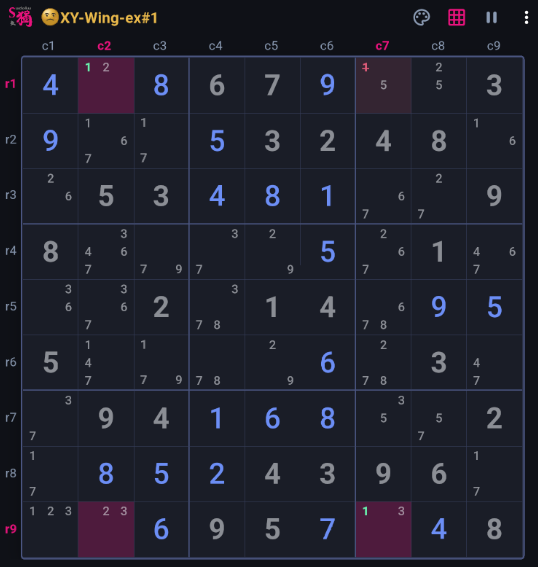
The pivot cell is r9c2 with numbers 2 and 3. One wing is r9c7 with numbers 1 and 3; the other wing is r1c2 with numbers 1 and 2. Both wings see the pivot, and both contain number 1.

If r9c2 is 2, then r1c2 cannot be 2, so r1c2 must be 1. If r9c2 is 3, then r9c7 must be 1. Either way, one wing is 1.

Any cell that sees both r1c2 and r9c7 therefore cannot be 1. In this case, cell r1c7 cannot be 1.

What to notice: In XY-Wing, the target does not need to see the pivot.
Placeholder for an XY-Wing walkthrough screenshot

Walkthrough

Example 02 — XY-Wing

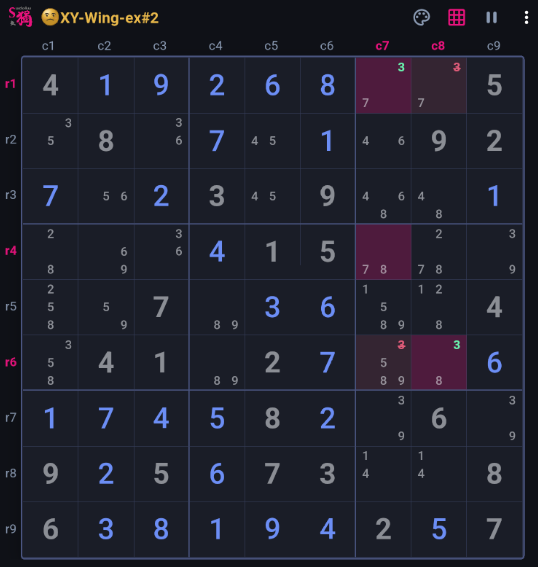
In this example, the pivot cell is r4c7 with numbers 7 and 8, two wings are r1c7 with numbers 3 and 7, and r6c8 with numbers 3 and 8. There are two target cells, both of them see two wings and both of them contains Z number 3, which can be elimiated from them.

What to notice: The useful part of an XY-Wing is not the shape by itself. After identifying the pivot and wings, look for cells that see both wings and still contain Z as a candidate.

Those cells are the elimination zone. Remove Z only from cells that see both wings; other nearby cells are not automatically affected.

Placeholder for a second XY-Wing elimination-zone walkthrough screenshot

How it works

WHICHEVER WAY THE PIVOT RESOLVES, ONE WING MUST TAKE Z.

The pivot can only be X or Y. If the pivot becomes X, the {X,Z} wing cannot use X and is forced to Z. If the pivot becomes Y, the {Y,Z} wing is forced to Z. Therefore at least one wing contains Z in every valid solution, so Z can be removed from any cell that sees both wings.

01

Find the pivot.

Start with a cell containing exactly two candidates, {X,Y}.

02

Find the wings.

Look for two bivalue cells that see the pivot: one with {X,Z} and one with {Y,Z}. The wings share Z, and they must not see each other.

03

Eliminate Z.

Any cell that sees both wings cannot contain Z, because one of those wings must contain Z.

WINGS 01

A useful reminder

THE PIVOT IS THE FORK; THE WINGS CARRY THE FORCED NUMBER.

Keep the logic separate from the visual shape. The pivot branches into X or Y, and each branch forces one wing to Z. That is why the target only needs to see the two wings.

Watch & learn

Watch live here.

Coming soon...

Practice

LOOK FOR BIVALUE CELLS FIRST.

When the grid has many two-candidate cells, choose a promising bivalue cell as the pivot. Test its visible bivalue neighbors for the {X,Z}/{Y,Z} relationship, then check the shared Z elimination zone. After an elimination, return to Singles, intersections, and subsets.