
Basic technique · 01

Scanning

Learn to sweep the grid with purpose: rows, columns, and boxes all tell you what can and cannot happen next.

BeginnerFoundationAlso known as cross-hatching

The idea

LOOK BEFORE YOU CALCULATE.

Scanning is the habit of sweeping rows, columns, and boxes to see what the existing numbers already rule out. It is the foundation underneath almost every beginner placement. Scanning is the habit of looking across the three houses that make up a Sudoku cell: its row, column, and 3×3 box. Instead of guessing a number, you first ask what the existing numbers already tell you, what are missing.

The question: What information is already visible here?

Walkthroughs

START WITH WHAT YOU CAN SEE.

A quick scan can solve certain cells quickly.

Walkthrough

Example 01 — Scan a house

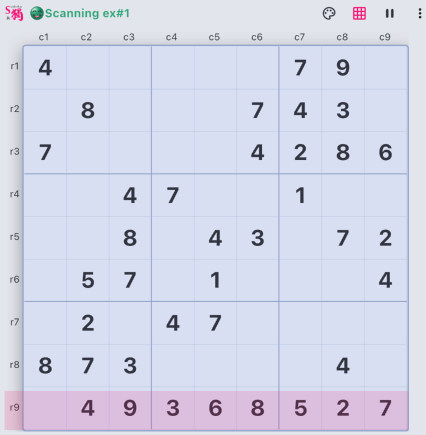
The first thing to notice via a quick scan is row 9, where only one unsolved cell left (a Full House). looking through all numbers presented in row 9, the missing number 1 is the solution

What to notice: Scan rows, columns, and boxex to find out which one has the most cells filled; a solution is revealed if there is only one empty cell in a house.
Placeholder for the example 01 — scan a house example puzzle screenshot

Walkthrough

Example 02 — Scan from three directions

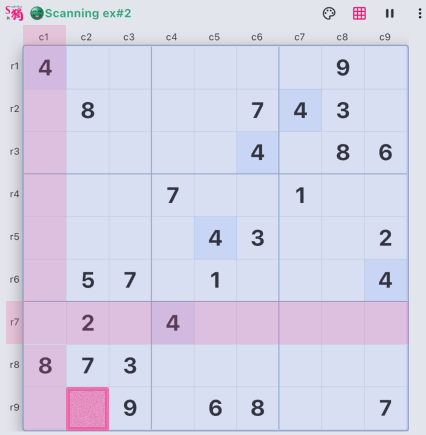
Digit 4 occupies row 7 and column 1, resulting only one empty cell r9c2 in box 7 where number 4 can be placed; so number 4 is the solution for that cell (Naked Single).

What to notice: Look at a specific number, trace the rows and columns where the number already appears to block out rows and columns in a target box, finding the only open space left for the number

Placeholder for the example 02 — scan from three directions example puzzle screenshot

How it works

THE GRID IS ALREADY GIVING YOU CLUES.

Every placed number restricts the cells that share its row, column, or box. Scanning simply makes those restrictions visible.

1

CHOOSE A NUMBER

Starting with the number that already appears several times, preferably with the one that appears the most; then follow where those placements restrict the empty cells. For any empty cell, remember that its row, column, and 3×3 box all participate in the decision.

2

SCAN THE ROW

Look across the row for the number that are already present and note the gaps.

2

SCAN THE COLUMN

Look down the column for the same number from a second direction.

3

SCAN THE BOX

Rows and columns where the number already appears block out the rows and columns in a box, resulting the only open space left for that number

A

A little history

NOT A SINGLE INVENTION.

Scanning is best understood as a natural solving habit that follows directly from Sudoku's rules. It is not generally credited to one inventor or a particular publication.

Watch & learn

Watch live here

Coming soon...

Practice

MAKE SCANNING A HABIT.

In the example 2 above, after placing 4 in cell r9c1, scan one more time and find the next cell where 4 can be placed, then scan again...