
Intermediate technique · 02

Locked Candidates

Use a box-row or box-column relationship to eliminate candidates.

Intermediate Pointing + Claiming Elimination

The idea

A NUMBER IN ONE HOUSE IS CONFINED TO ANOTHER HOUSE

Locked Candidates occurs when all possible locations for a number in one house are confined to another house. That relationship lets you eliminate the number from the rest of the intersecting house.

There are two directions: Pointing starts in a box and eliminates from a row or column; Claiming starts in a row or column and eliminates from a box.

The question: Is this number locked into one row or column within a box(Pointing) — or into one box within a row or column(Claiming)?

Walkthroughs

INTERSECTION OF BOX AND ROW/COLUMN

Locked Candidate is all about intersection of 2 houses.

Walkthrough

Example 01 — Locked Candidates: Pointing

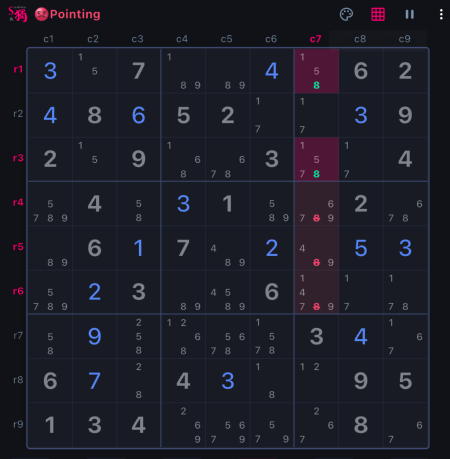
In this example, box 3 has number 8 locked to cell r1c7 and r3c7, so in its intersecting house, which is column 7 in this case, the rest cells cannot have number 8. This removes number 8 from cell r4c7, r5c7 and r6c7.

What to notice: Pick a number, then scan boxes to find out if the number is locked to a particular row or column.
Placeholder for a Locked Candidates walkthrough screenshot

Walkthrough

Example 02 — Locked Candidates: Claiming

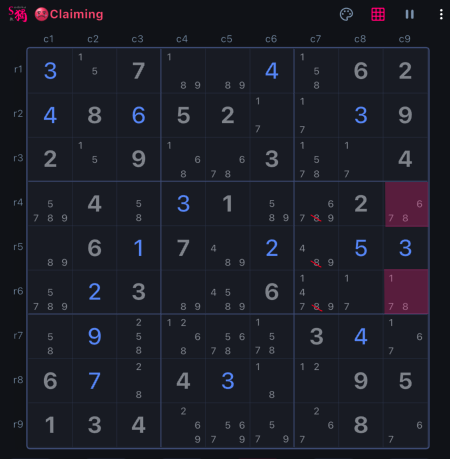
Look at this same example from a different angle: column 9 has number 8 locked to cell r4c9 and r6c9, and these two cells are also part of box 6; so in this intersecting house, the rest cells cannot have number 8. This removes number 8 from cell r4c7, r5c7 and r6c7, exactly the same deduction as in previous example.

What to notice: Pick a number, then scan rows or columns to find out if the number is locked to a particular box. Also notice that certain techniques are "exchangeable", meaning one or another gives the same deduction result. We will see this often later in other examples.

Placeholder for a Locked Candidates walkthrough screenshot

How it works

SEE THE CONSTRAINT, THEN USE IT.

A candidate does not need to be solved to give you information. If every possible location for a number inside one house lies in the same intersecting line, the rest of cells in the intersecting house cannot contain that number.

01

Choose one number.

Work with one candidate at a time.

02

Find the restriction.

For Pointing, check a box; for Claiming, check a row or column.

03

Eliminate outside the overlap.

Remove the candidate from the other cells in the intersecting house.

02

A useful reminder

THE PATTERN IS THE PROOF.

Pointing and Claiming are two candidate reduction techniques which remove a same set of candidates from other cells but from different angles.

Intersection, Pointing, Claiming, Locked Candidate Type 1, Locked Candidate Type 2 are related terms you may encounter while learning this technique. The important part is understanding the constraint and why the elimination follows from it.

Watch & learn

Watch live here

Coming soon...

Practice

MAKE LOCKED CANDIDATES A HABIT.

Once you can explain why the pattern is valid, practice finding it in a few real puzzle positions before moving on.