Advanced technique · Chains · 01

Remote Pairs

A chain of matching bivalue cells creates a shared elimination zone.

AdvancedChainsElimination

The idea

MATCHING BIVALUE CELLS ALTERNATE BETWEEN TWO NUMBERS.

A Remote Pairs is a chain made from bivalue cells that all contain the same two numbers, such as numbers 4 and 5. Consecutive cells see one another, so the value must alternate from one cell to the next. Similar to Simple Coloring, two connected cells can be assigned opposite colors, once the chain is colored, a useful contradiction appears.

Elimination: If an outside cell sees both colors, it cannot contain either of the two Remote Pairs numbers.

The question: Can the same two numbers be carried through a chain of bivalue cells?

Walkthroughs

FOLLOW THE ALTERNATING PAIR

Start with the repeated bivalue pair, then trace visible cells one link at a time. The useful deduction appears when consecutive cells are assigned opposite colors.

Walkthrough

Example 01 — A seven-cell Remote Pairs

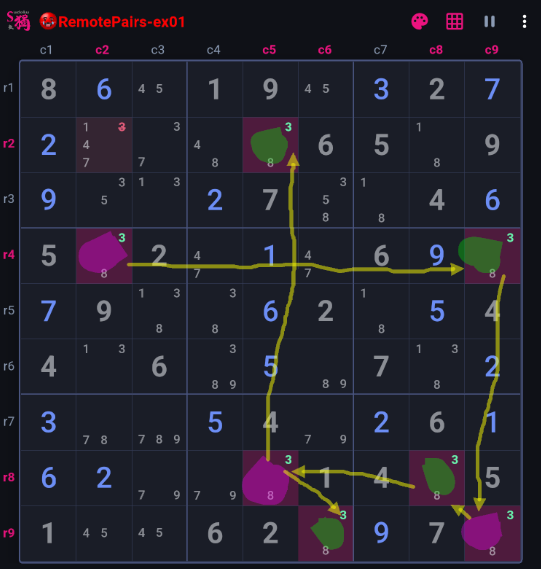
A chain of bivalue cells on number {3, 8} splits into two color sets {r4c2, r9c9, r8c5} and {r2c5, r4c9, r8c8 r9c6}, alternating between number 3 and 8 at every link. Cell r2c2 sees both colors, therefore, it cannot have either number 3 or number 8.

What to notice: A chain could have forks.

The drawing of yellow lines with arrows are for illustration only, the direction can be either way, the only decisive fact is the opposite coloring on two connected cells.

Do you know Naked Pair is the simplest Remote Pairs?
Placeholder for a Remote Pair walkthrough screenshot

Walkthrough

Example 02 — Find the shared elimination zone

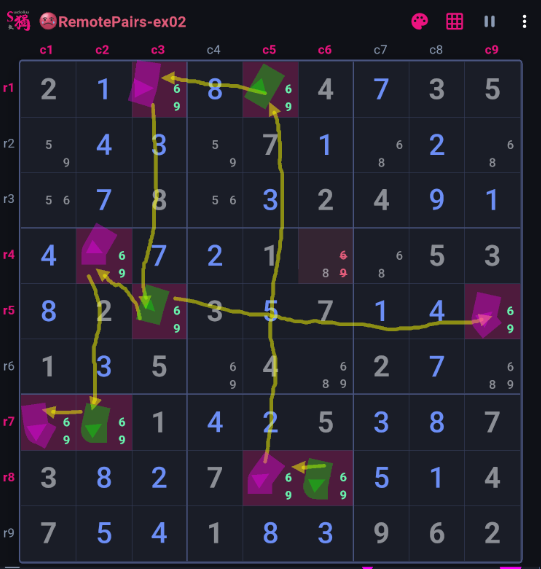
A chain of bivalue cells on numbers {6, 9} splits into two color sets {r1c3, r4c2, r5c9, r7c1, r8c5} and {r1c5, r5c3, r7c2, r8c6}, alternating between 6 and 9 at every link; cell r4c6 sees a cell from each color set, therefore it must avoid both numbers 6 and 9.

What to notice: A longer Remote Pairs may wind through several rows, columns, and boxes. Keep the same pair at every node and check that each consecutive cell sees the next.

An outside cell does not have to see chain's endpoints, as long as one sees two colors anywhere in the chain, that cell cannot have both numbers.

Placeholder for a Remote Pair walkthrough screenshot

How it works

TWO CONSECUTIVE CELLS HAVE OPPOSITE POLARITY, SO BOTH PAIR NUMBERS ARE BLOCKED.

Every bivalue cell in the chain contains the same two candidates. Moving from one cell to the next forces the candidate to switch. A cell that sees both colors would conflict with either possible value, so both numbers can be removed.

01

Find the pair.

Look for several bivalue cells containing exactly the same two candidates.

02

Build the chain.

Each consecutive cell must see the previous cell. Keep the same two candidates throughout.

03

Check the colors.

Two consecutive cells have opposite colors, any cell that see both colors can have both numbers removed.

CHAIN 01

A useful reminder

THE CHAIN PROVES OPPOSITE COLORS, NOT A SPECIFIC NUMBER.

Do not try to decide which cell starts the chain. The useful fact is that two consecutive cells must take opposite colors, so anything seeing both colors can contain neither number.

Watch & learn

SEE REMOTE PAIRS IN ACTION.

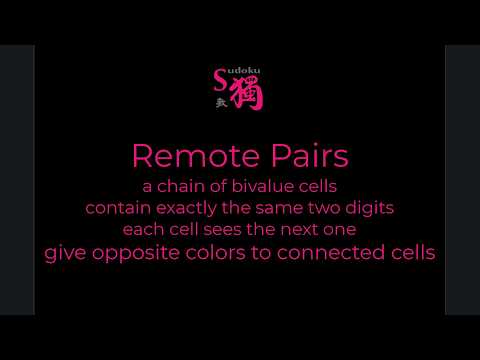
Walk through a puzzle to find a Remote Pairs. Along the way, breifly learn a few other techniques: pointing, claiming, X Wing, Two String Kite, Avoidable Rectangle, Hidden Pair, and Naked Pair.

Preview of the Remote Pairs Sudoku lesson Watch on YouTube Remote Pairs · Video lesson ↗

Practice

START WITH REPEATED BIVALUE PAIRS.

When a grid has many bivalue cells, look for a pair such as {4,5} that appears repeatedly. Trace only cells that see the previous cell and give them opposite colors, then check whether the an outside cell sees both colors.