
Advanced technique · Single Digit Pattern · 04

Simple Coloring

Color one number across strong links and let contradictions reveal eliminations.

AdvancedSingle Digit PatternsElimination

The idea

ONE NUMBER. TWO COLORS. ONE CONSISTENT LOGIC.

Simple Coloring is actually a specialized variantion of X-Chain, which follows a single number through a network of all strong links. Each strong link connects two cells, so the cells can be assigned opposite colors.

Once the network is colored, two useful contradictions appear: the same color may occur twice in one house, or a candidate outside the network may see both colors. Either situation gives an elimination.

Elimination: if an outside cell sees both colors, that cell cannot have the number; if two same color cells see each other, all cells of that color cannot have the number.

The question: What does the two-color network tell you about where this number can and cannot go?

Walkthroughs

BUILD THE COLOR NETWORK FIRST

Coloring works best when you separate construction from deduction. First build the strong-link network for one number. Then inspect it for contradictions.

Walkthrough

Example 01 — Alternate colors along strong links

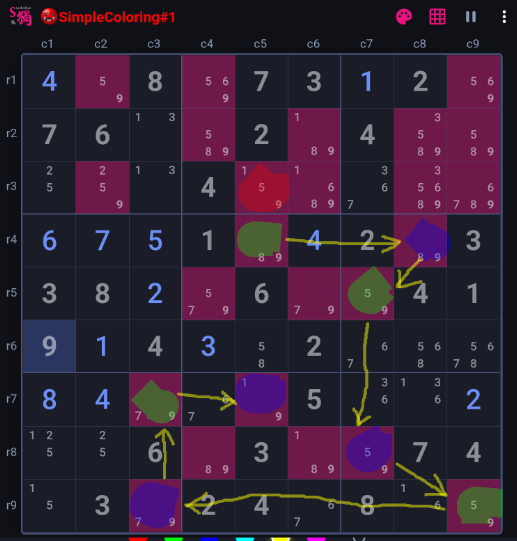
Digit 9 forms 8 strong links starting from cell r4c5 and ending at cell r7c5 as illustrated below; 'starting' cells r4c5, r5c7, r9c9, and r7c3 are 'colored' in green, while their strong-linked partner cells r4c8, r8c7, r9c3 and r7c5 are in a different 'color' set.

Because each strong link contains at least one true number 9, the two colors represent the two possible polarities of the network: one color is true throughout the chain, or the other color is.

The outside cell r3c5 sees both colors, therefore it can not be number 9.

What to notice: The colors are not guesses. They are labels for the two possible ways the strong-link network can resolve.
Placeholder for a Simple Coloring network walkthrough screenshot

Walkthrough

Example 02 — A double kill

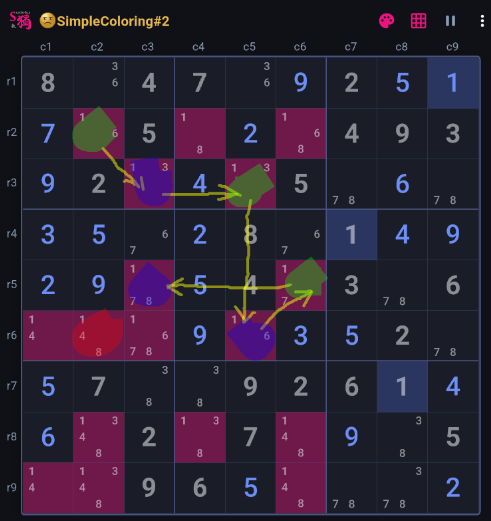
Digit 1 forms a strong link network with a first color set of cells r2c2, r3c5 and r5c6, and a second color set of cells r3c3, r6c5 and r5c3; since cell r6c2 sees both colors, therefore it cannot have number 1.

Look further, if two candidates with the same color see each other, that color cannot be true. Every candidate of that color in the connected network can therefore be eliminated.

Here two cells r3c3 and r5c3 from the second color set are in the same column 3 so they see each other, therefore all three cells in the second color set cannot have number 1,

What to notice: This particular pattern can actually be solved using a less complicated technique: Skyscrapter, can you find it? This proves that a puzzle can be solved using different approaches.

Placeholder for a second Simple Coloring contradiction walkthrough screenshot

How it works

THE TWO COLORS REPRESENT TWO POSSIBLE RESOLUTIONS.

Every strong link says at least one endpoint is true. Alternating colors across the network lets you reason about both possible polarities at once. A contradiction eliminates the color or candidate responsible for it.

01

Choose one number.

Look for a connected network of strong links for that number.

02

Alternate the colors.

Give each candidate one of two colors, switching colors across every strong link.

03

Find the contradiction.

Use same-color conflict or a candidate that sees both colors to make the elimination.

SDP 04

A useful reminder

COLOR THE LINKS, THEN TEST THE COLORS.

Do not treat a color as a number assignment. It represents one side of a two-way logical network. The deduction comes only after you find a contradiction.

Watch & learn

SEE SIMPLE COLORING IN ACTION.

Walk through a few puzzles to find Simple Coloring patterns. Along the way, learn a few other techniques such as pointing, naked pair, skyscraper and w-wing.

Preview of the Simple Coloring Sudoku lesson Watch on YouTube Simple Coloring · Video lesson ↗

Practice

BUILD SMALL COLOR NETWORKS.

Choose one number with several strong links. Start from one candidate, alternate two colors through the connected network, then check houses for same-color conflicts and nearby candidates that see both colors. Keep the network small until the logic becomes familiar.