
Advanced technique · Fish · 02

Swordfish

One number. Three rows. Three columns.

AdvancedFishElimination

The idea

ONE NUMBER IS CONFINED TO THREE ROWS AND THREE COLUMNS.

A Swordfish expands on the logic of an X-Wing by using 3x3 grid patten.

Row based: a row based Swordfish occurs when one number is restricted across three rows, and all of its candidate cells in those rows lie within the same three columns. The rows are the base sets; the columns are the cover sets.

Column based: a column based Swordfish occurs when one number is restricted across three columns, and all of its candidate cells in those columns lie within the same three rows. The columns are the base sets; the rows are the cover sets.

The question: Do three rows(or columns) contain all of their candidates for one number inside the same three columns(or rows)?

Walkthroughs

FOLLOW ONE NUMBER ACROSS THREE BASE ROWS OR COLUMNS

A Swordfish is an expanded X-Wing: three base lines replace two, and three cover perpendicular lines replace two. The key is the total positional structure, not a perfect-looking shape.

Walkthrough

Example 01 — Row-based Swordfish

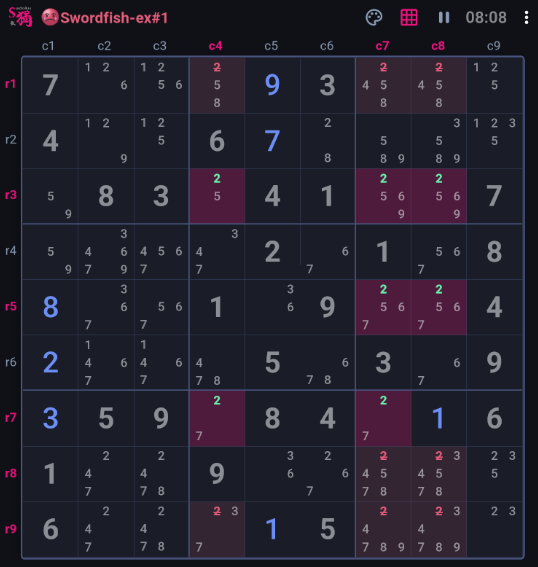
Digit 2 appears in rows 3, 5 and 7 only appears within columns 4, 7 and 8. The three rows collectively contain every candicdate for number 2 within those three columns. Therefore number 2 can be removed from rest of cells in columns 4, 7 and 8.

What to notice: The three base rows must place their 2s somewhere among those three cover columns. Any other candidate 2 in those columns outside the base rows can therefore be eliminated.

The candidate distribution does not have to form a complete 3-by-3 rectangle. One row may have two candidates and another may have three, as long as all candidates in the three base rows fit within the same three cover columns.
Placeholder for a Swordfish walkthrough screenshot

Walkthrough

Example 02 — Column-based Swordfish

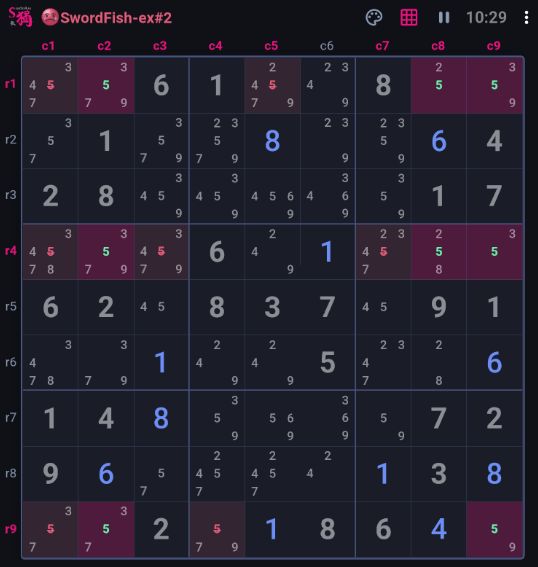
Digit 5 appeared in column 2, 8 and 9 only appears within row 1, 4, and 9. The three columns collectively contain every candidate for number 5 within those three rows. Therefore number 7 can be removed from rest of cells in rows 1, 4 and 9.

What to notice: Do not search for a perfect visual shape. Count three base lines and three distinct cover lines, then verify that every relevant candidate is contained within that structure.

Placeholder for a Swordfish walkthrough screenshot

How it works

THREE BASE LINES RESERVE THREE PERPENDICULAR COVER LINES.

The three base lines each need a place for the fish number, but all of their candidate positions are contained in the same three perpendicular lines. Those three perpendicular lines therefore must contain the number in the three base lines. Other candidates for that number in those cover lines can be eliminated.

01

Find the fish number.

Choose one number and look for three base lines whose candidate positions for that number are contained in a small set of perpendicular lines.

02

Confirm the cover lines.

Across the three base lines, all candidate cells for the number must lie within the same three perpendicular lines.

03

Eliminate outside the base lines.

Remove that number from other candidate cells in the three cover perpendicular lines, while leaving the Swordfish candidates themselves intact.

FISH 02

A useful reminder

THE FISH IS ABOUT COVERAGE, NOT A PERFECT SHAPE.

The useful result is outside the three base lines. Once the three cover perpendicular lines contain all possible placements for the number from the base lines, other candidates for that number in those cover lines cannot be part of the solution.

Watch & learn

Watch live here.

Coming soon...

Practice

LEARN TO SEE THREE LINES AT ONCE.

Choose one number and scan rows(or columns) for candidate positions. When three rows(or columns) collectively restrict that number to no more than three columns, test the structure carefully. After an elimination, return to Singles, intersections, and subsets before searching for another fish.