
Advanced foundation

Strong & Weak Links

Learn the candidate relationships behind many advanced Sudoku deductions.

AdvancedFoundationCandidate Logic

The idea

CANDIDATES CAN BE CONNECTED BY WHAT THEY FORCE.

A strong link tells us that if one is false, the other one must be true. A weak link tells us that if one is false, the others could be true.

To be more specific, a strong link tells us that if one is true, the other one must be false; if one is false, the other one must be true. A weak link tells us that if one is true, the others must be false; however, if one is false, the others might or might not be true.

The question: What does this relationship let me conclude if one candidate is true or false?

Walkthroughs

START WITH THE SIMPLEST LINKS

A strong link involes two cells or two numbers; a weak link involves more.

Walkthrough

Example 01 — A strong link in a house

Digit 6 can appear in only two cells of column 7: r4c7 and r9c7. The 6 must occupy one of those two cells. If r4c7 is not 6, then r9c7 must be 6.

What to notice: The two candidates are strongly linked because the house guarantees that at least one must be true.
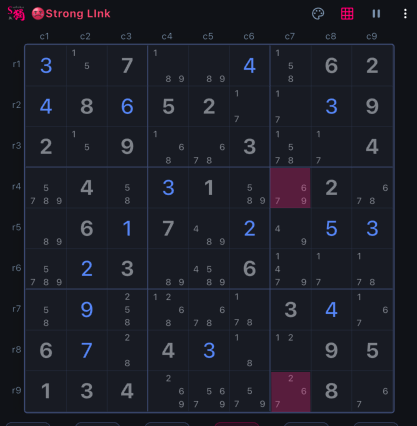
Placeholder for a strong link example

Walkthrough

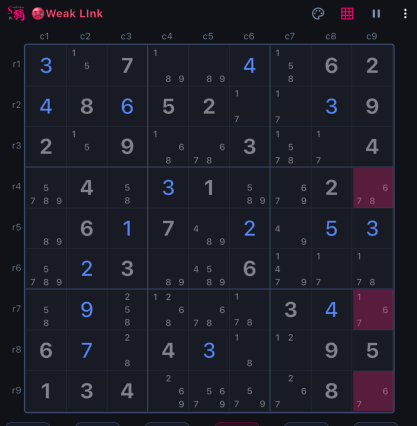
Example 02 — A weak link between seeing candidates

In column 9, the same number 6 is the candidate of three cells: r4c9, r7c9 and r9c9. if one of those three cells is not 6, it is still uncertain which of other two cells is 6.

What to notice: A weak link does not tell us that if one is false, which of others is true;

Placeholder for a weak link example

How it works

STRONG SAYS “ONE OR THE OTHER.” WEAK SAYS “ONE OR OTHERS.”

The words describe the logical relationship, not how important or powerful a candidate is. The same number can sometimes has both a strong and a weak relationship at once.

01

Recognize a strong link.

Conjugate Pair: if a number has only two possible cells in a house, one of those two cells must contain the number. If one is false, the other is forced. Those two cells form a strong link on that number.

Bivalue Cell: if a cell has only two candidates, one of those two candidates must be the solution. If one is false, the other is forced. Those two candidates have a strong link in that cell.

02

Recognize a weak link.

Inside a house: if a number appears three or more times in a house, cells containing that number form a weak link on that number, if one is false, any of others could be true.

Inside a cell: if a cell has three or more candidates, then if one candidate is false, any of others could be true. Those candidates form a weak link in that cell.

03

Use the relationship.

Advanced techniques connect these relationships so that a chain, pattern, or structure produces a safe candidate elimination.

00

A useful reminder

STRONG AND WEAK DESCRIBE THE LOGIC, NOT THE DIFFICULTY.

A strong link is not “better” than a weak link. They answer different questions. Strong links help carry a forced possibility forward; weak links tell us which possibilities cannot coexist. Together, they become the vocabulary for many later patterns. Strickly, a strong link is also a weak link, but has a special feature.

Watch & learn

Watch live here.

Coming soon...

Next

LET US GO FISHING.

You do not need to memorize every advanced technique at once. Start by recognizing the relationships between candidates, then see how a Fish pattern turns those relationships into a larger structural elimination.

Continue to Fish →