
Advanced technique · Uniqueness · 08

BUG+2

Two exceptional cells break the BUG pattern and create a shared uniqueness constraint.

AdvancedUniquenessElimination

The idea

TWO EXCEPTIONAL CELLS MUST TOGETHER PREVENT THE BUG.

A BUG+2 is an extension of BUG+1 in which two cells break the otherwise bivalue pattern. The exact deduction depends on the candidate distribution in those cells, but the uniqueness constraint remains the same: if both exceptional cells were reduced in a way that restored a complete BUG, the puzzle would lose uniqueness. At least one of the candidates that prevents that BUG must therefore be true.

The question: What candidate relationship keeps the two exceptional cells from collapsing into a BUG?

Walkthroughs

TREAT THE TWO EXCEPTIONS AS ONE UNIQUENESS CONDITION

Start with the BUG structure, then verify there are two cells with three numbers(exceptional cells) that can break the BUG before making the elimination.

Walkthrough

Example 01 — Two cells break the pattern

All unsolved cells are bivalue except two cells r4c3 and r5c3, each containing an extra number 5. Removing extra number 5 would restore the exact BUG pattern, the puzzle cannot allow both exceptions to disappear. Therefore, any cell that sees both exceptional cells must have number 5 removed.

What to notice: BUG+2 does not automatically place one of the two extras. It creates a relationship that must be resolved from the actual candidate arrangement.
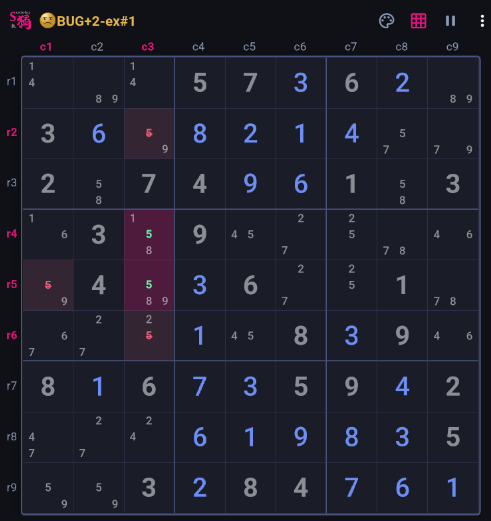
Placeholder for a BUG+2 walkthrough screenshot

Walkthrough

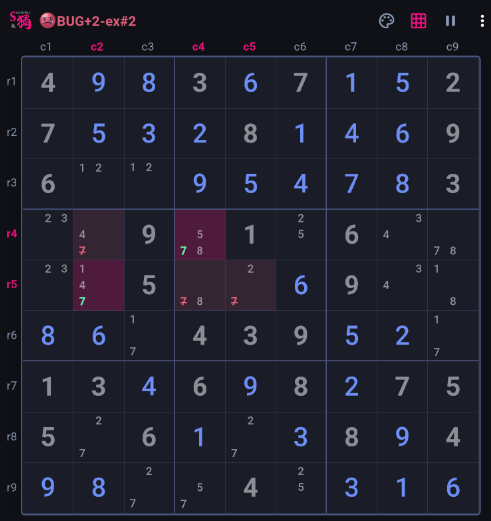
Example 02 — Find the common candidate

Two exceptional cells here are cells r4c4 and r5c2, both of them contains number 7 plus other two numbers each; One of them must contain number 7 or otherwise a BUG would exist. Therefore any cell that sees both of them can eliminate number 7.

What to notice: Two cells with three numbers do not have to be in a same house, once you prove that at least one exception must contain that candidate, remove the candidate from other cells that see all of the relevant exceptional cells.

Placeholder for a second BUG+2 walkthrough screenshot

How it works

THE TWO EXCEPTIONS CANNOT BOTH ALLOW THE COMPLETE BUG.

If the exceptional candidates were all removed in a way that restored the BUG state, the grid would admit the forbidden non-unique configuration. Therefore the exceptional candidates carry a collective constraint: at least one of the candidates that breaks the BUG must remain true. The exact elimination depends on where those candidates occur.

01

Find the two exceptions.

Reduce the grid to its BUG-like bivalue structure and identify the two cells that break it.

02

Track the breaking candidates.

Check their unit counts and any candidates they share or force into common houses.

03

Use the collective constraint.

Eliminate a candidate only when the two-cell relationship proves it cannot occur in the target cell.

BUG + 2

A useful reminder

BUG+2 IS A RELATIONSHIP, NOT A SINGLE-CELL RULE.

Unlike BUG+1, the two exceptional cells do not automatically tell you which candidate is correct. First establish what must be true to prevent the BUG, then make the resulting elimination.

Watch & learn

Watch live here.

Coming soon...

Practice

VERIFY THE BUG COUNTS FIRST

Find a grid with two exceptional cells and verify that removing their extra candidates would restore the BUG condition. Then trace the candidates that must remain to prevent that state. If the relationship is not clear, do not force a BUG+2 move.