
Advanced technique · Wings · 02

XYZ-Wing

A three-candidate pivot connects two bivalue wings around one shared number.

AdvancedWingsElimination

The idea

A TRIVALUE PIVOT AND TWO BIVALUE WINGS SHARE THE ELIMINATION NUMBER.

An XYZ-Wing is an extension of an XY-Wing, it uses a pivot with exactly three candidates, {X,Y,Z}. One wing is {X,Z}; the other is {Y,Z}. Both wings see the pivot but must not see each other, and Z is present in all three pattern cells. It eliminates Z from any cell that sees all three cells.

The question: Can a three-candidate pivot connect two bivalue wings that both contain the same third number?

Walkthroughs

THREE NUMBERS PIVOT WITH TWO NUMBERS WINGS

Same as with an XY-Wing, but the pivot cell has three candidates, and a target must see pivot as well.

Walkthrough

Example 01 — XYZ-Wing

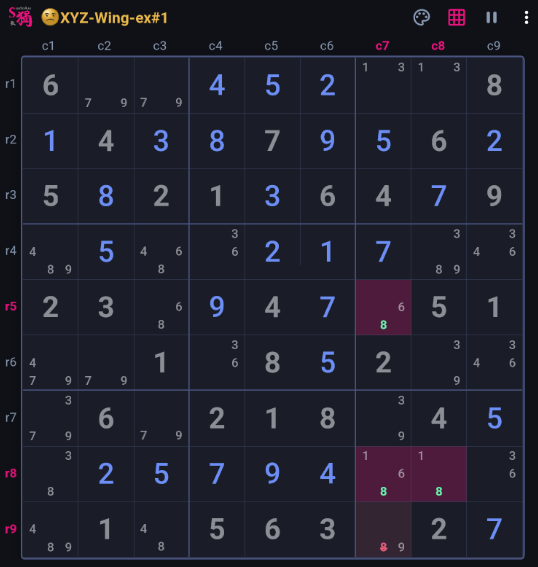
The pivot is r8c7 with numbers 1, 6 and 8. One wing is r8c8 with numbers 1 and 8; the other wing is r5c7 with numbers 6 and 8. The shared number is 8.

If r8c7 is 1, then r8c8 must be 8. If r8c7 is 6, then r5c7 must be 8. If r8c7 is 8, the pivot itself is 8.

In every case, one of the three cells is 8. A cell such as r9c7 therefore loses candidate 8 because it sees all three pattern cells.
Placeholder for an XYZ-Wing walkthrough screenshot

Walkthrough

Example 02 — XYZ-Wing

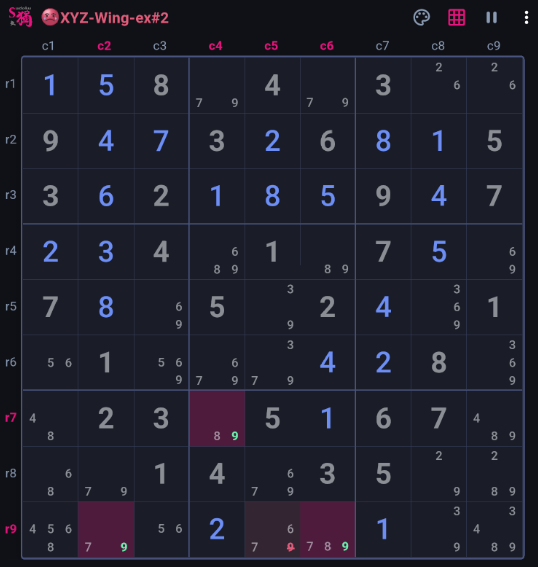
This example has the pivot cell r9c6 with numbers 7, 8 and 9, where one wing cell r9c2 has numbers 7 and 9, and another wing cell r7c4 has numbers 8 and 9, this eliminates number 9 from the target cell r9c5, which sees all three cells of the pattern.

What to notice: XYZ-Wing looks similar to XY-Wing, but the elimination zone is smaller. In XY-Wing, the pivot does not contain Z, so the target only needs to see the two wings.

In XYZ-Wing the pivot also contains Z. If the target cannot see the pivot, it has not ruled out the case where the pivot itself becomes Z.

That is why every XYZ-Wing elimination must be checked against all three pattern cells.

Placeholder for a second XYZ-Wing target-zone walkthrough screenshot

How it works

Z MUST APPEAR IN THE THREE-CELL STRUCTURE.

If the pivot becomes X, the {X,Z} wing is forced to Z. If the pivot becomes Y, the {Y,Z} wing is forced to Z. If the pivot itself becomes Z, Z is already present at the pivot. So one of the three cells must contain Z. Because Z is possible at the pivot itself, an elimination target must see all three pattern cells.

01

Find the pivot.

Start with a cell containing exactly three candidates, {X,Y,Z}.

02

Find the wings.

Find two bivalue cells that see the pivot: one with {X,Z} and one with {Y,Z}. Both wings must use candidates from the pivot and cannot see each other, i.e., they are in two seperate houses.

03

Confirm the target.

Eliminate Z only from a cell that sees the pivot and both wings. The target must see all three because the pivot itself can be Z.

WINGS 02

A useful reminder

XYZ-WING IS NOT JUST A LARGER XY-WING.

The extra candidate in the pivot changes the proof and the elimination zone. The shared number Z can live at the pivot, so the target must see the pivot as well as both wings.

Watch & learn

Watch live here.

Coming soon...

Practice

START WITH TRIVALUE CELLS.

When scanning for an XYZ-Wing, start with cells that have exactly three candidates. Compare their visible bivalue cells against the pivot candidates, looking for the {X,Z}/{Y,Z} structure. Once found, search only the cells that see all three pattern cells.