
Advanced technique · Fish · 03

Jellyfish

One number. Four rows. Four columns.

AdvancedFishElimination

The idea

ONE NUMBER IS CONFINED TO FOUR ROWS AND FOUR COLUMNS.

A Jellyfish expands on the logic of an X-Wing by using 4x4 grid patten.

Row based: a row based Jellyfish occurs when one number is restricted across four rows, and all of its candidate cells in those rows lie within the same four columns. The rows are the base sets; the columns are the cover sets.

Column based: a column based Jellyfish occurs when one number is restricted across four columns, and all of its candidate cells in those columns lie within the same four rows. The columns are the base sets; the rows are the cover sets.

The question: Do four rows(or column) contain all of their candidates for one number inside the same four columns(or rows)?

Walkthroughs

FOLLOW ONE NUMBER ACROSS FOUR BASE ROWS OR COLUMNS

Jellyfish extends the same fish principle one step beyond Swordfish. Four base lines and four cover perpendicular lines create the positional restriction; the candidate distribution does not have to fill every intersection.

Walkthrough

Example 01 — Row-based Jellyfish

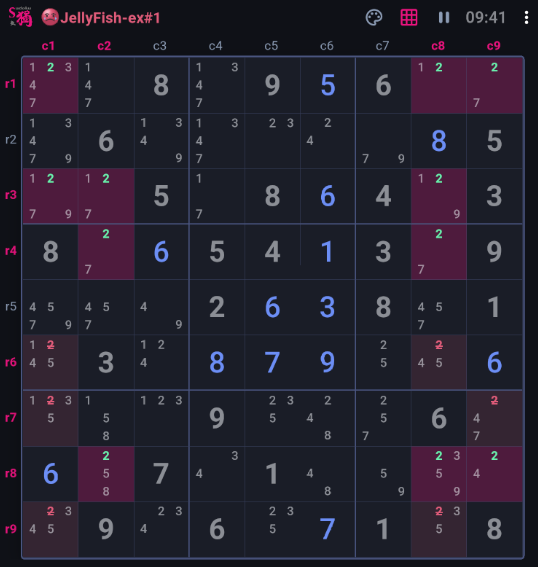
Digit 2 appeared in rows 1, 3, 4, and 8 only appears within columns 1, 2, 8, and 9. The four rows collectively contain every candidate for number 2 within those four columns. Therefore number 2 can be removed from rest of cells in columns 1, 2, 8 and 9.

What to notice: The four 2s required by the four base rows must occupy the four cover columns. Any other candidate 2 in those columns outside the base rows can therefore be eliminated.

A sparse Jellyfish is still a Jellyfish, the pattern does not require a 4-by-4 block of sixteen candidate cells. Some row-column intersections can be empty; what matters is that all candidates in the four base rows are covered by the same four columns.
Placeholder for a Jellyfish walkthrough screenshot

Walkthrough

Example 02 — Column-based Jellyfish

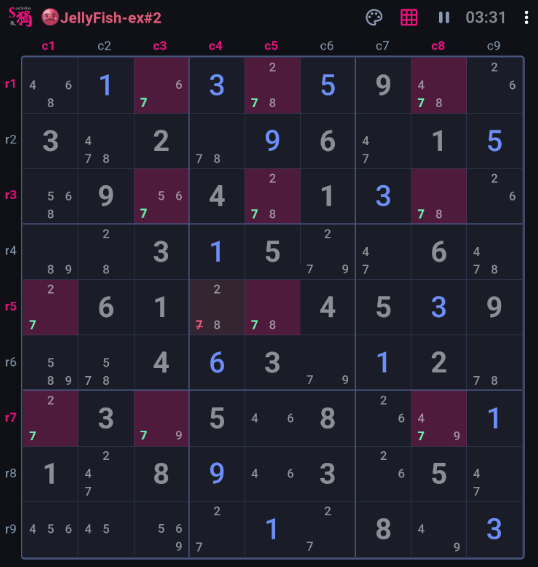
Digit 7 appeared in columns 1, 3, 5, and 8 only appears within rows 1, 3, 5, and 7. The four columns collectively contain every candidate for number 7 within those four rows. Therefore number 7 can be removed from rest of cells in rows 1, 3, 5 and 7.

What to notice: Think in terms of four base sets and four cover sets rather than a visual square. The coverage relationship is the proof.

Placeholder for a Jellyfish walkthrough screenshot

How it works

FOUR LINES RESERVE FOUR PERPENDICULAR LINES.

The four base lines must place the fish number among the same four cover perpendicular lines. That leaves no room for another occurrence of the number in those perpendicular lines outside the four base lines, so those outside candidates can be eliminated. Here if a base line is a row, then a perpendicular line is a column; if a base line is a column, then a perpendicular line is a row.

01

Find the fish number.

Choose one number and look for four base lines whose candidate positions for that number are contained within a small set of perpendicular lines.

02

Confirm the four cover perpendicular lines.

Across the four base lines, all candidate cells for the number must be contained in the same four cover lines.

03

Eliminate outside the base lines.

Remove that number from other candidate cells in the four cover lines, leaving the Jellyfish structure itself untouched.

FISH 03

A useful reminder

THE BIGGER FISH STILL USES THE SAME LOGIC.

Jellyfish is not a new kind of logic. It is the same single-number fish principle with four base sets and four cover sets. Larger basic fish exist, but they are outside this curriculum for now.

Watch & learn

Watch live here.

Coming soon...

Practice

LEARN THE STRUCTURE, NOT THE SIZE.

Choose one number and look for four rows(or columns) whose candidates fit inside four columns(or rows). Verify the full candidate coverage before making any elimination. Afterward, update the grid and return to simpler techniques before looking for another advanced pattern.