
Advanced technique · Uniqueness · 09

BUG+3

Three exceptional cells extend BUG reasoning into a broader candidate relationship.

AdvancedUniquenessElimination

The idea

THREE EXCEPTIONS CARRY THE CONSTRAINT THAT PREVENTS THE BUG.

A BUG+3 extends the same BUG idea to three exceptional cells. The rest of the unsolved grid is bivalue, while three cells contain the additional candidates needed to break the BUG state. There is no single universal placement rule like BUG+1; the useful deduction comes from proving which of those exceptional candidates must remain in order to preserve uniqueness.

The question: Which candidate relationship among the three exceptional cells prevents the BUG?

Walkthroughs

TRACE THE THREE EXCEPTIONS WITHOUT LOSING THE BUG STRUCTURE

Start with the BUG structure, then verify there are three exceptional cells that can break the BUG before making the elimination.

Walkthrough

Example 01 — Three cells break the BUG

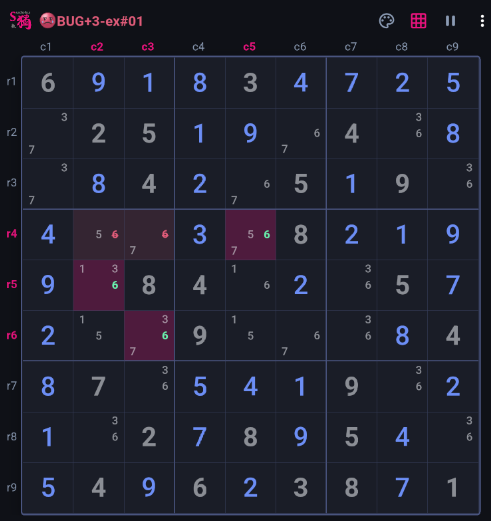
Three exceptional cells r4c5, r5c2 and r6c3 all contain number 6 plus extra two numbers each. One of them must contain number 6 to avoid BUG pattern, therefore, number 6 can be removed from any cell that sees all of them.

What to notice: BUG+3 is about the candidate network around the exceptions, not simply counting to three. Similar to BUG+2, three exceptional cells do not have to be in a same house.
Placeholder for a BUG+3 walkthrough screenshot

Walkthrough

Example 02 — Use the common elimination zone

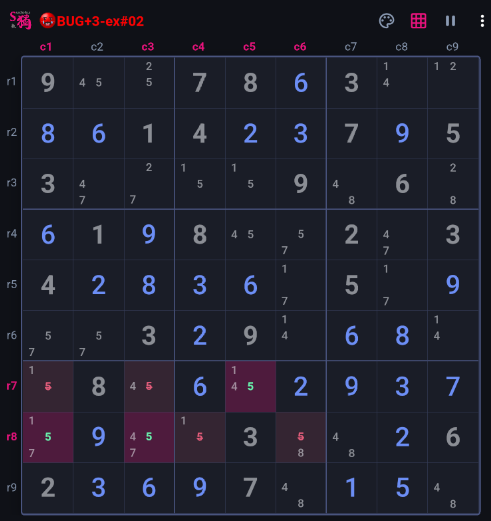
Here three exceptional cells are r7c5, r8c1 and r8c3 with number 5. Any cell that sees all of them should not have 5 as its candidate.

What to notice: Recognition and proof are separate skills. Seeing three exceptional cells is only the beginning.

When the three exceptional cells share a useful candidate, identify the cells that see every exception carrying that candidate. Those cells cannot contain it if at least one exception must take the number.

If no clean common relationship appears, stop. BUG+3 is a specialized pattern and should not be forced when ordinary subsets, chains, or other advanced relationships give a clearer proof.

Placeholder for a second BUG+3 walkthrough screenshot

How it works

THE EXCEPTIONS MUST COLLECTIVELY PREVENT THE COMPLETE BUG.

A complete BUG would be non-unique. With three exceptional cells, the puzzle remains unique only because their additional candidates prevent that state. The deduction comes from identifying a candidate that must survive in at least one exception and then applying the resulting constraint to cells that see all of the relevant exceptions.

01

Find the three exceptions.

Confirm that the remaining unsolved cells are bivalue and that the three cells are the only breaks in the BUG-like pattern.

02

Track their extra candidates.

Check how those candidates are distributed through the affected rows, columns, and boxes.

03

Prove the elimination.

Only remove a candidate when the three-cell relationship guarantees that at least one exception must contain it.

BUG + 3

A useful reminder

BUG+3 IS AN EXTENSION, NOT A REQUIRED EVERYDAY MOVE.

The pattern is useful when it appears cleanly, but it is considerably more specialized than BUG+1. Keep the proof explicit and prefer a simpler established technique when one is available.

Watch & learn

Watch live here.

Coming soon...

Practice

LOOK FOR A CLEAN THREE-CELL PATTERN

When almost every unsolved cell is bivalue, identify the three cells that break the pattern. Verify the BUG-like counts, then look for a candidate that must survive in at least one exception. If you cannot prove the shared constraint, keep searching.