Advanced technique · Chains · 07

Nice Loop

Alternating Inference Chains connect strong and weak links into a closed loop.

AdvancedChainsPlacement / Elimination

The idea

NICE LOOP GENERALIZE THE CYCLE IDEA.

A Nice Loop is a closed loop of an AIC that uses the same idea of alternating strong and weak links with multiple numbers. The idea lets you move beyond one-number cycles such as X-Cycle or simple bivalue patterns such as XY-Cycle..

With Nice Loop technique, the concept of links, i.e., Strong Links and Weak Links, is broader. Every earlier technique, such as X-Chain, Turbot Fish, Simple Coloring, and X-Cycle, etc., only ever has cell-to-cell links: same digit, two different cells sharing a house. XY-Chain, XY-Cycle, the general AIC and Nice Loop introduce a genuinely different kind of link — within one bivalue cell, between its own two candidate digits.

Similar to X-Cycle and XY-Cycle., Nice Loops are classified into Discontinuous Nice Loops and Continuous Nice Loops.

Elimination: A Continuous Nice Loop supports eliminations candidates from cells connected to the loop and sharing a weak link with the loop nodes; while a Discontinuous Nice Loop can create a contradiction that proves either a placement (two strong links) or an elimination (two weak links).

The question: Can the candidate links alternate all the way around a loop?

Walkthroughs

READ THE LOOP AS A PROOF

Alternating strong and weak links of multiple numbers until you find a perfect closed loop. Then find the loop type to make eliminations or a placement accordingly.

Walkthrough

Example 01 — Continuous loop

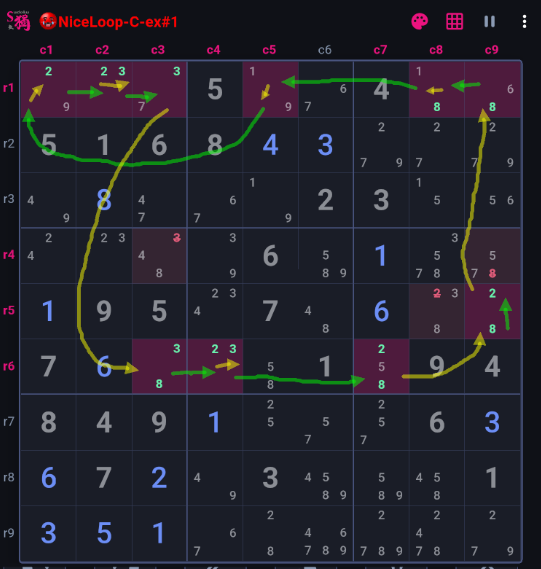
The loop on number 1, 2, 3, 8 and 9 is illustrated below with green strong links and yellow weak links. The loop starts from cell r1c1, if cell r1c1 were not number 2, then cell r1c2 must be number 2(strong link), then cell r1c2 could not be number 3(weak link), then cell r1c3 must be number 3(strong link), then cell r6c3 could not be number 3(weak link), then cell r6c4 must number 3(strong link), then cell r6c4 could not be number 2(weak link), then cell r6c7 must be number 2(strong link), then cell r5c9 could not be number 2(weak link), then cell r5c9 must be number 8(strong link), then cell r1c9 could not be number 8(weak link), then cell r1c8 must number 8(strong link), then cell r1c8 could not be number 1(weak link), then cell r1c5 must number 1(strong link), then cell r1c5 could not be number 9(weak link), then cell r1c1 must be number 9(strong link), then back to the starting cell, where cell r1c1 could not be number 2.

This is a perfect continuous loop that alternates cleanly all the way around, the loop can be flollowed in either direction (try it yourself).

Because the loop closes without a break, every weak-link end cells in the loop behave as a forced pair and one of them must contain linked number. Therefore, any cell that sees both ends of a weak link can have linked number eliminated. As it shows, number 3 can be removed from cell r4c3 because it sees two end cells r1c3 and r6c3 of a weak link on linked number 3; similarly, number 2 is removed from cell r5c8, and number 8 is removed from cell r4c9.

What to notice: A continuous loop is not simply a longer X-Chain; it can move between different candidates and different kinds of links..
Placeholder for a continuous X-Cycle walkthrough screenshot

Walkthrough

Example 02 — Discontinuous loop with two strong links

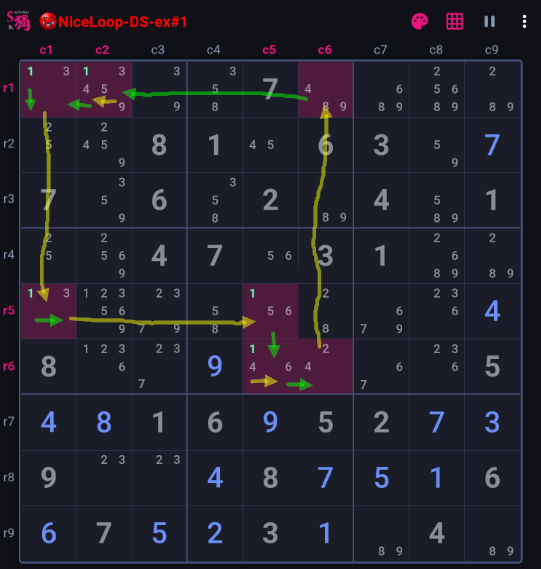
This loop on numbers 1, 3 and 4 with strong and weak links is illustrated below. If the starting cell r1c1 were not number 1, it must be number 3(strong link), then cell r5c1 could not be number 3(weak link), then it must be number 1(strong link), then cell r5c5 could not be number 1(weak link), then cell r6c5 must be number 1(strong link), then cell r6c5 could not be number 4(weak link), then cell r6c6 must be number 4(strong link), then cell r1c6 could not be number 4(weak link), then cell r1c2 must be number 4(strong link), then cell r1c2 could not be number 1(weak link), then cell r1c1 must be number 1(strong link). Both the first and the closing link touching cell r1c1 are strong, so cell r1c1 must be number 1.

What to notice: Two numbers in a bivalue cell can act as a strong or weak link between them. A strong link says if one is false, the other must be true; a weak link says if one is true, the others must be false

Placeholder for a Nice Loop / AIC walkthrough screenshot

Walkthrough

Example 03 — Discontinuous loop with two weak links

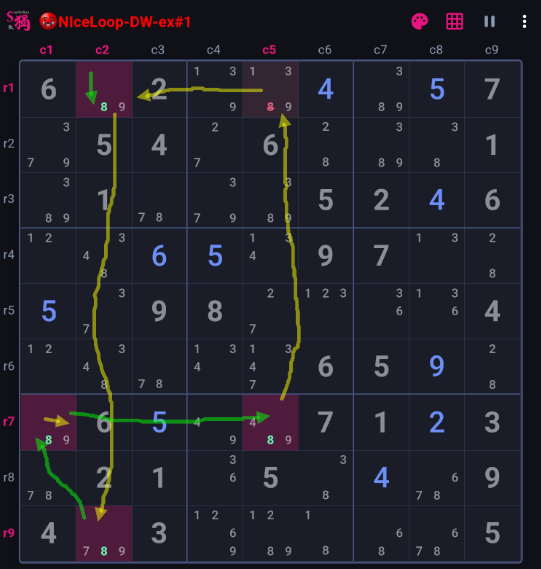
This loop on numbers 8 and 9 is illustrated below with green strong links and yellow weak links. The loop starts from bivalue cell r1c2, where its number 8 and 9 forms a strong link; if cell r1c2 were not number 8, it must be number 9(strong link), then cell r9c2 could not be number 9 (weak link), then r7c1 would be forced to number 9 (strong link), then cell r7c1 could not be number 8 (weak link), then cell r7c5 would be forced to number 8 (strong link). The loop breaks at cell r1c5, where two weak links meet, therefore, cell r1c5 cannot be number 8.

What to notice: The same elimination can be achieved by using AIC, where cell r7c4 sees both end cells r2c4 and r7c8 of the chain.

Placeholder for a Nice Loop / AIC walkthrough screenshot

How it works

THE CLOSING LOOP TELLS YOU WHAT THE LOOP PROVES.

Similoar to X-Cycle and XY-Cycle, think of the Nice Loop as an alternating ON/OFF argument for multiple numbers. In a continuous loop, the alternation of strong and weak links remains consistent all the way around, so each weak-link pair becomes a guaranteed either/or relationship. In a discontinuous loop, the closing point breaks that pattern. The type of break determines whether the candidate is forced ON or OFF.

01

Choose a bivalue cell.

Start with a bivalue cell, follow alternating strong and weak links involving multiple numbers.

02

Close the loop.

If you are able to reach back to the start point, determine if the loop is continuous or discontinuous.

03

Read the closure.

Continuous: eliminate the number from cells that see both ends of a weak-link pair. Two strong links at the discontinuity: place the number. Two weak links at the discontinuity: eliminate the number.

CHAIN 07

A useful reminder

THE LOOP TYPES MATTER MORE THAN THE SHAPE.

Nice Loops become much easier to understand when you follow strong and weak links on multipe numbers. Remember a bivalue cell can also act as a strong or weak link.

Watch & learn

Watch live here.

Coming soon...

Practice

WRITE THE LINKS DOWN.

For early practice, annotate a candidate loop with strong and weak links before looking for the deduction. Once the alternating structure is clear, inspect the closure for the consequence.